A "Warm Season Wrap-up"
By Rob Bettaso
When our nights take on the bite of cold weather and dawn and dusk have become chilly enough to warrant wearing a jacket, I know that the time has come for me to consider writing another “warm-season wrap-up” article for the Outdoors Southwest magazine. The reason for this is simple: during most of the year when our weather is pleasantly warm, I am outdoors much more than I am during the cooler (and darker) portion of the year. As such, by this time of year I have enjoyed numerous outings that I simply have not had time to share, and so I like to do so by writing brief summaries (or vignettes) in a composite article that says goodbye to summer.
The first summary pertains to a camping trip I took with my friend Dan in May. Dan and I have known each other for over 30 years, and during much of that time, we both worked for the Arizona Game and Fish Department (AZGFD). Dan still works for AZGFD as their “Nongame Biologist” for the Pinetop Region and conducts wildlife research on frogs, snakes, hummingbirds, and bats (to list just a few of his project areas). For our one-night camping trip along the rim of a deep and rugged canyon between Pinetop and Flagstaff, our goal was to check for Peregrine Falcons breeding at a historic nesting site.
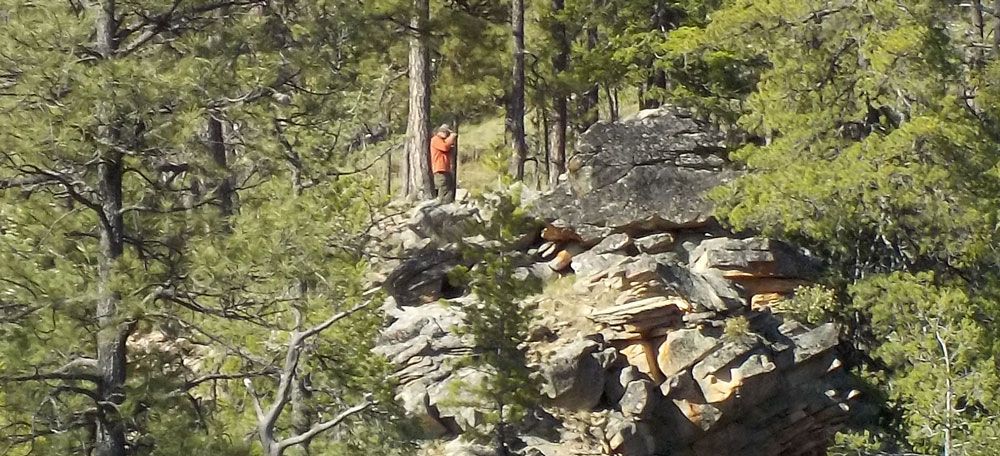
We drove to (and camped in) an area a few miles from the old nesting site and set up our cots within a grove of sparse pines. Although it was mid-morning, I was already looking forward to the evening’s stargazing in the clear-air of our high-elevation terrain. After a snack, we hiked along a road that the Forest Service had closed to vehicular traffic, and before long came to a spine-like ridge with deep canyons along either side of the spine. Dan used his maps and GPS to find the location where we would spend much of our day scanning both the skies and canyon walls looking for falcons (flying, perching, or on a ledge that might serve as a nesting site).
Field biology is sometimes nothing more than very long periods of time spent in one location waiting for an animal to reveal itself or to allow itself to be observed (often using binoculars, a spotting scope, a camera, or a sound-recorder). In between long-stretches of scanning our environment, we would take turns exploring the adjacent areas or just spend time chatting and studying the realm of our surveying location. For example, this year there was a bumper-crop of cicadas and so, for a short while, I spent my time counting the clicking little critters as they flicked their wings among the foliage of the abundant manzanitas. I also took a stroll to identify the local birds in our area and noted that there seemed to be healthy populations of Western Tanagers and Western Wood Pewees. Both bird species are avid insectivores, and it seemed highly possible that the major emergence of cicadas contributed to the concentrated numbers of these two bug-eating birds.
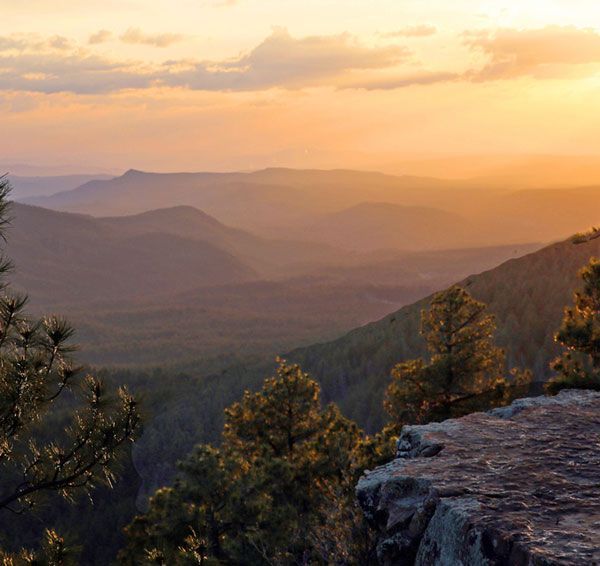
Toward the end of our day’s monitoring, when Dan’s occasional recorder play-backs of vocalizing falcons would not attract any interest among local Peregrines, he said that it would be ok if I explored further along the rocky spine between the two canyons to see if I could hear any vocalizing adults or nestlings on the hidden ledges below. With the setting sun and the lengthening shadows, both canyons were dramatically lit, and the narrow route along the spine was stunning along both my sides. The footing was reasonably sound, but it was dizzying because of the fairly precipitous drop-offs along my route. Suddenly, in a patch of blue-sky I saw a falcon in my peripheral vision and turned my head to get a better look; sure enough, it was the size and shape of a Peregrine but due to the angle of the sun; I did not get a clearly lit view of the streaking bird. I watched him for a minute before he wheeled up and into a side-canyon and disappeared from view. Before it got any darker, I high-tailed it back to our monitoring point and excitedly told Dan about the event. We agreed it was too late now to do any more work, but that tomorrow we’d return and hope for another, and better, sighting.
On the hike back to camp, we watched a “blue moon” rise and used our flashlights to make sure we didn’t trip along the trail. Even though we hadn’t exerted ourselves physically during our monitoring, we were both tired so, after dinner and conversation, we went to our respective cots and wound down the evening watching plenty of bright, celestial bodies including Venus, Jupiter, and the Twins: Castor and Pollux. Off and on through the night, we could also hear the soft hooting of a Great-horned Owl and the nearly constant call of a lone (and lorn) Mexican Whip-poor-will; somewhat unusual for these parts.
Early the next morning (after hiking past yesterday’s monitoring site and out onto the spine where I had seen the adult falcon), it didn’t take us long to get lucky. Since we hadn’t yet resorted to playback, perhaps just our presence was enough to provoke the cries of what we decided were a couple of Peregrine nestlings. We never got a view of the young or the adults, but we could tell that the nesting ledge must have been somewhere down the cliffs of the spine on some secret spot that was invisible from our vantage point.
We stayed a while longer and never did get a view of the falcons, but also we didn’t want to impede the adults from doing what they needed to do: fly and hunt for prey so that they could feed their young. Dan filled out the data sheets. We returned to camp, and Dan used a neat little portable French press to make us a couple of cups of strong coffee, which we drank while packing up and loading the truck. Soon we were heading back to town, which would end my time looking for peregrines at this site. Dan would return in the days ahead; though he never verified the nest with any visual sightings of adult or young birds. Sometimes field biology provides strong, but inconclusive, evidence of one aspect or another of an animal’s life history.
My next vignette is also from a Mogollon Rim area canyon. In fact, the comparisons and contrasts between the two canyons are perhaps worth noting. The falcon canyon was deep and narrow; and though it contained a perennial stream, the waterway was intermittent in its long, twisty route to the Little Colorado River. The second canyon, which I will call crawdad canyon (because of its being infested with those destructive, nonnative crustaceans), was shallow, broad, and contained a stream that is both perennial and continuously flowing from its source to where it empties into the Verde River (which is part of the Gila River drainage).
Both canyons were also trips I took with former colleagues at AGFD. For Crawdad Canyon, my companion was Mike, a fellow fisheries biologist, who is also perhaps the most skilled and dedicated angler I’ve ever known. It was Mike who suggested the trip, as he was planning to fly-cast for native Gila Trout as well as nonnative trout and any other fish species that might be biting. Mike knows that I’m not an angler, but he figured I would be thrilled at the prospect of birding this canyon, as it possesses a vibrant riparian ecosystem which, in June, would be extremely active with nesting songbirds.
I had been to parts of Crawdad Canyon over my years with AZGFD, but it had been a very long time since my last visit. As such, when we arrived at the trailhead, I was surprised to see that, given the massive human population growth in the area, the Forest Service (FS) was now charging a day-use fee to enter the canyon. I will confess to mixed feelings upon learning that I was entering a fee area: on the one hand, I was totally bummed that the stream had been “discovered” by the teaming masses, but on the other hand, I was relieved that the FS was limiting use by charging a fee (although I’m skeptical that there was much in the way of law enforcement — namely, permit checking — by FS personnel in the area).
No sooner had Mike and I started down the canyon when Mike commenced fishing a deep pool while I walked into a thick bosque-type habitat and was dazzled by an abundance of very active song-birds. Before long, Mike had caught a nice trout, and I had identified four species of gorgeous warblers. Mike’s catching fish and my observing a variety of bird species described the primary activity of our entire day, which probably ran for three hours of slow and extremely enjoyable downstream progress, and then a similar hike back up the drainage. Besides indulging our hobbies, we also took in the dazzling array of geologic landforms, including cliffs, hoodoos, massive boulders, and an entire stream-bottom filled with beautiful and interesting cobblestones, pebbles, and patches of well-sifted, golden sand.
My third and final vignette pertains to a one-night backpacking trip I did with Gary, a friend of some 10 years whom I met because we both volunteer with the Navajo County Search and Rescue team. Gary needed to get out and field-test some new gear on an overnight trip to make sure he would be ready for a much longer backpacking trip he had planned for later in the summer. We were actually allowing ourselves two nights to backpack a 12-mile loop route that was supposed to run downstream along one fork of a river and then back up another fork of the same river.
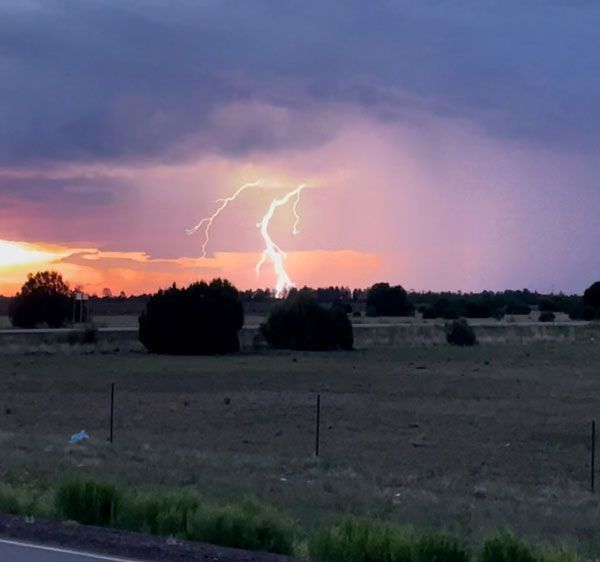
Our trip was in late June and the summer monsoons were just kicking in, but not as predictable afternoon rains, but randomly, at nearly any time of day. Our trail downstream was well-established and our progress was steady despite our heavy backpacks and a flare-up of knee pains I suffer from periodically. After hiking the four miles of the one fork, we filtered river-water to fill our canteens and discussed whether we should proceed to the second fork. I had previously hiked the downstream fork on day trips in the past, but had never done the return fork and figured it would be like the one we had just finished. Gary, who had never hiked either fork had done some research prior to our departure and informed me at this point that he thought the return fork was without a trail and would be too rugged for us to hike (cliffing-out and forcing us to hike through deep pools et cetera). Instead, he thought we should take an upland route and could find springs that were visible on both our soft- and hard-copy maps.
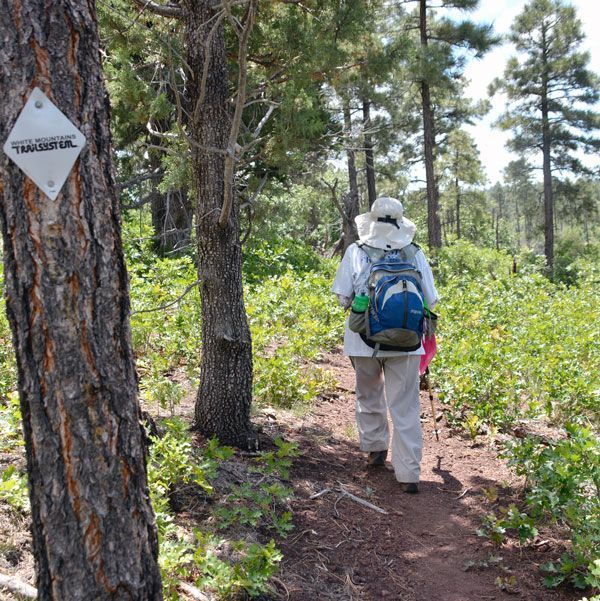
We started up a steep mountain grade and hiked for several hours before levelling out along a ridge. The scenery was incredible, and there had been no sign of people since we left the stream. It felt like we had an entire Lost World to ourselves and, despite my aches and pains, I hiked in a state of bliss. Unfortunately, at every spring we came to, the sites were dry, and so we worried about having enough water to make it comfortably back to Gary’s truck; still another several miles of hard hiking.
A sudden squall forced us to make a decision, and we camped along a mostly grassy plateau and pitched our tents among some young aspens to be protected should the storm bring strong winds. For the next several hours the rain came down in a steady, wonderful light shower, and I spent my time reading and sleeping in my tent. When the rains stopped, both Gary and I emerged and decided we would spend the night here and then hike back to the truck the next day and not spend a second night due to the dry springs and the strong possibility of more rain.
The next day dawned cloudy with the threat of rain. Nonetheless, we enjoyed a leisurely but long hike back to the trailhead. At the truck, the skies were so dark that we opted to return home. A house and yard may not be as beautiful as a wildland’s camp, but it is nonetheless much roomier than my claustrophobic one-person tent.