A memorial to a great historian
By Anne Groebner
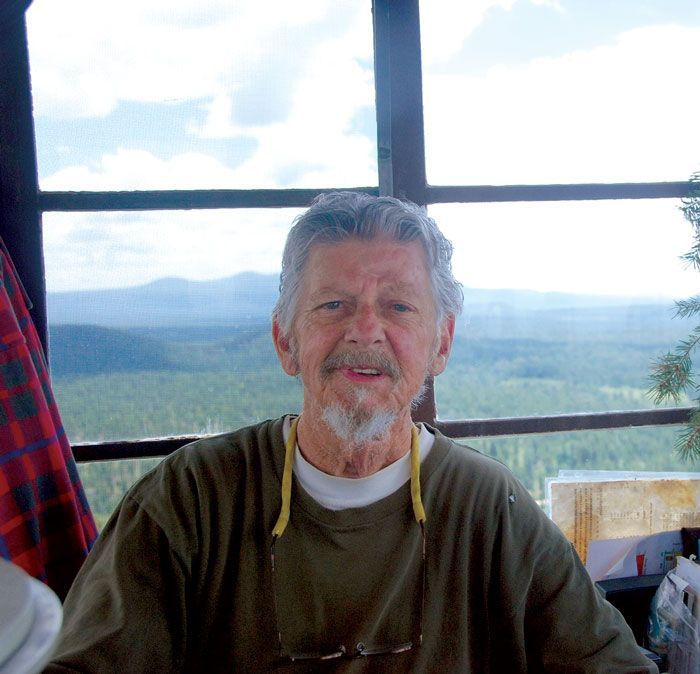
Anthony Cooley may have left us this October, but he left us much wiser and knowledgeable about the history of the White Mountains. His family’s residency dates back to the Civil War in New Mexico and Arizona. Anthony was a former president of the Pinetop-Lakeside Historical Society, and in 2010, recorded an oral history for the Arizona Memory Project. He also wrote many articles. I worked with him at the White Mountain Independent and heard his many stories of backcountry adventures in the White Mountains. When I created the Take A Hike column for the Independent, he and Jerry Ethelbah took me cross-country skiing up Mount Ord. It took us three hours to reach the top and 50 minutes to get back down to the bottom. I spoke with him last year about writing for the Outdoors SW Magazine, but unfortunately, his health deteriorated, and this year, a couple of months past his 80th birthday, he passed away.
His great-grandfather, Corydon E. Cooley (C.E.), was a lieutenant and quartermaster of the Second New Mexico Volunteer Infantry in the Civil War, 1862. When they disbanded the first, through fourth volunteer infantries and created just one New Mexico volunteer cavalry, he re-enlisted and fought under Kit Carson. Around Christmas,1862, he requested sick leave and eventually resigned his commission and took up residency in a hot spring in New Mexico, which he managed.
Eventually, he moved to Prescott, and he, Henry Dodd, and A.F. Banta set out prospecting for gold and silver. Their travels took them to Arizona, where they ran into hostiles and returned to Prescott. However, while he was in the White Mountains, he discovered they were building Fort Apache and moved back and married Chief Pedro’s daughter, Mollie — Chief Pedro (also known by his Apache name, Hacke-yanil-tli-din) was a prominent 19th-century leader of a Coyotero / White Mountain Apache band in Arizona during the Apache Wars — Mollie’s sister, Cora, came with her. They built a small cabin on the north fork of the White River near Diamond Creek, did some farming and sold vegetables to the folks who were building Fort Apache.
Cooley learned the Apache language and became one of the few people who was able to translate straight from Apache to English without having to go through various steps — and the Apaches trusted him to translate correctly. As Cooley is settling down in the territory, Vincent Colyer, an American artist, shows up in 1871 to advocate for reservations including the White Mountain Apache Reservation and many other Arizona reservations. Anthony says he has a letter C.E. wrote describing how Coyler’s policies were working and that people were peaceful and happy.
In 1872, General Otis Oliver Howard (they called him the “praying General”) shows up to re-establish the reservations. He met with Chief Cochise and established (for the first time) peaceful relations with the Chiricahuas and gave them the Chiricahua Mountains for their reservation.
General Crook took aggressive action to ensure peaceful relations and formed a band of four cavalry, 30 Apache Scouts and a sergeant. C.E. signed up to fight with them and to be an interpreter and guide. Back then, a Scout earned $13 per month, a sergeant earned $15 per month, and since C.E. had two jobs, interpreter and guide, he earned $125 per month. The Apache Scouts were far better than the cavalry. The soldiers rode horseback and often could not venture into territory like the Apache Scouts could, who were on foot. About four Apache Scouts earned the Medal of Honor, including Chief Alchesay. However, his medal did not show until 50 years after his death.
One story that kind of floats around the area is how Show Low got its name. As the legend goes, Will C. Barnes claims that while stationed at Fort Apache in 1880, C.E. told him this: C.E. and Marion Clark were neighbors in the Mogollon Rim Area. They decided around 1876 that the region wasn’t big enough for both of them, so they would play a card game to see who stayed and who had to leave. They played the game Seven-Up, where a low card wins. Clark told C.E. that if he could show a low card, he would win. C.E. threw down the Deuce of Clubs and said, ”Show Low it is!” However, Anthony believes it was an earlier card game that inspired the name. One played in 1872 between C.E. and Henry Dodd to see who won the rights to ranch the area. 1876 records show that Marion Clark lived in Yavapai County.
Anthony’s dad, Richard Cooley, was a member of the White Mountain Apache Tribe. He was one quarter Apache, and in 1924, the government granted him United States citizenship. He went to high school in Globe and fought in World War II. His grandfather, Don, and his wife Anne moved to Fort Apache for work, and she was the postmistress of the Fort Apache Post Office. In 1935, the family moved to Cibecue and built a trading post called Apache Traders, which housed the Cibecue Post Office, and that’s where Anthony grew up. On summer vacations from school, Anthony spent a lot of time at the Kinishba Ruins. His father was the Livestock Manager there, and Anthony greeted visitors and documented license plates. He had a vast knowledge of the ruins and the ancient people that built them and lived there.
Fortunately, a lot of the history that Anthony gathered and recorded is still with us. You can look up the oral histories through the Arizona Memory Project at https://azmemory.azlibrary.gov/nodes/view/164470
People will always remember him for his kindness and the memories he created.
Rest in Peace, Anthony.