Celebrating 100 Years of the Lake Mountain Lookout
By Jane Croxen
Photos by Anne Groebner
Two vintage photos submitted
Built in 1926 atop Lake Mountain, the 48-foot Aermotor LX-24 lookout and lookout cabin are in active service. The original ladder was replaced in the 1930s with stairs. The National Register of Historic Places lists the lookout and the nearby Los Burros Ranger Station site.
Have you ever heard a tall tower tell a tale? Or how about a tall tale told by a tower? Lake Mountain Lookout, a 48-foot tall lookout tower on the Apache-Sitgreaves National Forests, has a few tales to tell. Well, why else do you call the events about a 48-foot tall tower? What else, but “tall tales!”
Westward ho the wagons! Exploration and settlement of the western lands in America were rapidly taking place in the 1800s. February 1905 was an important year for the United States Department of Agriculture (USDA) Forest Service. Congress established this new agency to conserve federal forested lands and manage them for the benefit of the American people. Shortly thereafter in 1910, the Los Burros Ranger District was delineated on the newly established Sitgreaves National Forest in east central Arizona. Smoke detection and fire suppression were among the mandated objectives, much as they are today, for public safety and the wise management of our natural woodland resources.
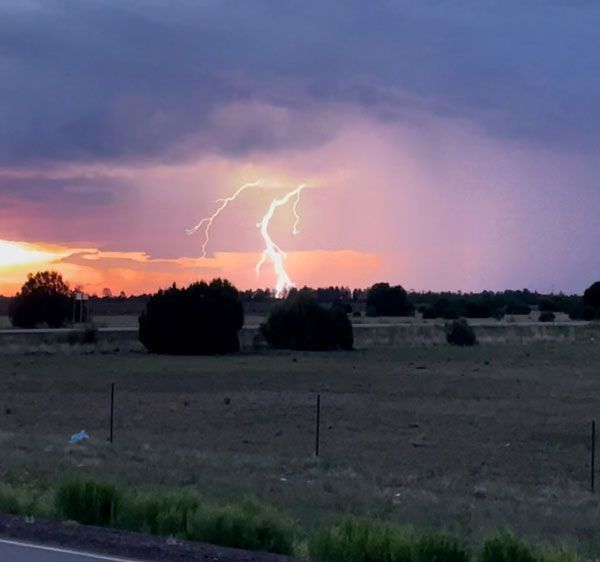
Initially, many forest service ranger districts utilized tall pine trees on strategic mountain tops to obtain the best vantage point for observation. Lake Mountain, just a short horseback ride from the Los Burros Ranger Station, offered such a distinction. There, a prominent, sturdy ponderosa pine was chosen to become the district’s lookout tree. Railroad spikes driven into the tree’s sides enabled a forester to climb up and remove the top branches. At the top, an observation platform was built. When climbed after lightning storms, if smoke was spotted, notification of the smoke was achieved by a telephone inside a weatherproof box. With telephone cables supported by insulators mounted on branches, the relayed smoke report descended the mountain to the Los Burros Ranger Station. With the advent of better communication technology a few years later, this original system was no longer maintained. Amazingly, at Lake Mountain, the Lookout Tree with a mounted telephone box about four feet up on the tree’s trunk was still present as late as 1994, the box directly facing the cabin. In the interim years to the present, this tree died and fell, with the few remaining pieces turned to ash, being burned during a prescribed broadcast burn in 2024.
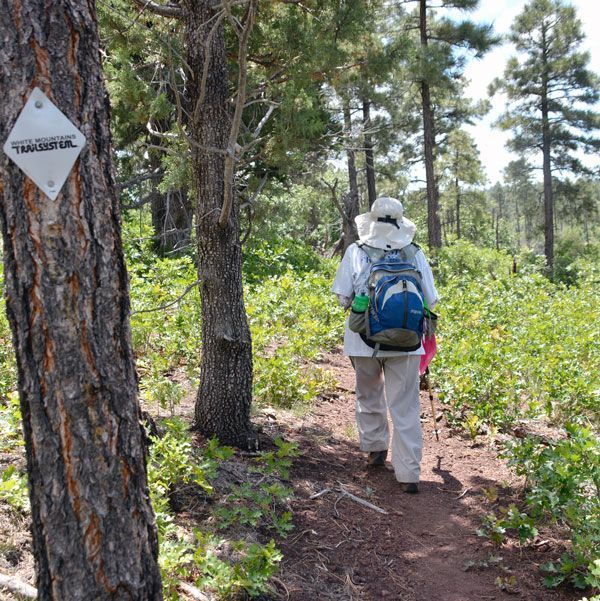
Commonly, the first comments most intelligent, inquisitive visitors to Lake Mountain make are, “How can a lake have a mountain?” Or “How can a mountain have a lake?” Which is it? What’s with the name? “A rose by any other name would…, hey! Don’t pay attention to that Shakespeare guy! Let’s get back on point! Yes, at the point, or tippy-top, of most volcanoes is the vent where an active volcano spouts molten lava. Sometimes, a depression, geologically termed a caldera, forms (think cauldron) because the volcano collapses back in on itself. Crater Lake is the most well-known caldera in the United States, with a “cauldron” or lake depth of 2,148 feet. Lake Mountain is a caldera, also, and practically right here in our own backyard! Its depth, though, is only deep enough to create a pretty blue marsh after the winter’s snowpack melts. Check it out sometime. The Los Burrow Trail will lead you there.
Initially, tree-top observation stands were implemented from 1905 to 1911, but during and after World War I, the Forest Service lookout system became better funded and more standardized. Metal towers were erected on these prominent mountain tops, replacing the prior tree stands. Lake Mountain received an Aeromotor tower in 1926. The metal towers included a mounted compass developed for improved accuracy of detected smoke locations. These were Osborne Fire Finders mounted in the center of each tower cab. The towers also afforded much greater comfort, now allowing increased hours for observation by regularly staffed personnel.
Now that we know where we’re going, load into or onto your chosen means of transportation, and let’s get up the mountain. The 100-year-old lookout tower has some tales to tell!
Around the summer of 1976, the Lake Mountain Lookout named Claire was about to end her work day at 5:00 p.m. when she called her supervisor, Julie, on the Forest Service radio. “What do I do? I’m in the tower, and I can’t come down! There’s a bear on the second landing!” Julie responded, “No, don’t come down!” Shortly thereafter, Claire got a call from the Fire Management Officer saying, “Stay put. Engine 75 is on its way!” When the engine arrived, the guys opened up several cans of C-rations from their engine’s cache. They threw the food on the lower stairs, and the bear was enticed to come down — eating up the World War II rations all the way!
There must be something about those stairs! An unfortunate incident involved an older couple who were staffing the tower. On one warm summer morning, the gentleman left the cabin, his stomach comfortably full with the hearty breakfast his wife had prepared. Ascending the tower stairs to start his workday, he never made it to the top. Sadly, on the way up the 48-foot staircase, he suffered a fatal heart attack. No amount of rations would be a remedy for this one.
Now, back to Claire, who, along with her husband, Blackey, staffed Lake Mountain for about 20 years. In the midst of her tower observations, one day, a low-flying single-engine plane clipped the tall pine on the west side of the mountain and crashed just twenty feet below the tower. The crash started a fire, and the two people on board were killed. As one can imagine, the experience disturbed Claire, and she had difficulty reporting the accident on the radio, but she did eventually get the message across.
Alan Allen staffed Lake Mountain Lookout for over thirty years, starting his vigil in 1994. He fell in love with “his” mountain top, capturing the lure of the life afforded there in his poetry, below:
A remote 100-year-old rustic studio
Tightly quartered — working office suite
A metal and glass — seven-foot-square cubicle
With lightning rods — thrust upwards forty-eight feet
Watchtower aloft — anchored to Terra Mogollon
Like a monolith where Earth and Sky meet
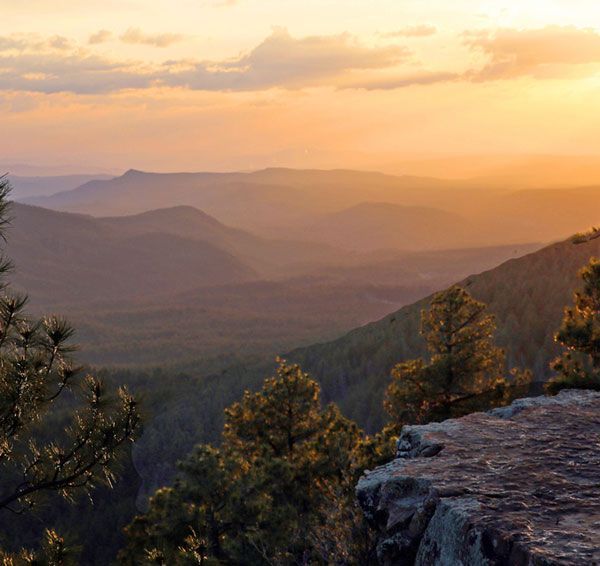
With breathtaking panoramic 360-degree view
Lightning struck — wind blown — sun bleached
Storm drenched
That’s Lake Mountain for you.
The tower has stood the test of time: one hundred dry summer fire seasons, one hundred ripping windy springs, one hundred frozen winters. With bears, airplanes, and heart attacks and admiring poets, the tower stands as a tough survivor, a metal monolith that has provided one hundred years of service to the Apache-Sitgreaves National Forests. Let’s ask if it’s ready for one hundred more! How about our applause? Let’s hear it!