Leopold's weekend retreat in Baraboo, Wisconsin
Article and photos by Anne Groebner
I traveled 1,520 miles to the southern sand counties of Wisconsin to see a shack nestled on the sandy banks of the Wisconsin River. A prairie savanna surrounds it — all native species of plants and pine and other numerous trees. Every plant and every tree planted by the late conservationist Aldo Leopold and his family — over 30 to 50 thousand trees and hundreds of acres of grasslands. It is the Aldo Leopold Shack and Farm, stewarded by the Aldo Leopold Foundation. A foundation that was established by Leopold’s five children to protect and preserve the land and intellectual property of their father. The Foundation owns all copyrights, including that of Oxford University Press. Here I met marketing director, Andy Radtke, at the Exhibit Hall, and he graciously gave us a tour of the facilities, including the shack, and gave us a ton of information.
In 2007, builders constructed the visitor center and exhibit hall using about 600 of the trees planted by Leopold and his family on the property. It was highly ranked as a green building because it uses geothermal and solar energy, but mostly because workers cut, milled, and used all the existing timber. Other buildings on the property include Seed Hall, which is a meeting and lecture hall, and the Future Leader Center, which houses fellows, usually first-year undergraduate students. The Foundation provides one-year fellowships; two in communication and marketing and two in landsteading. They spend an entire year stewarding the land, including burning to restore habitat for grassland birds.
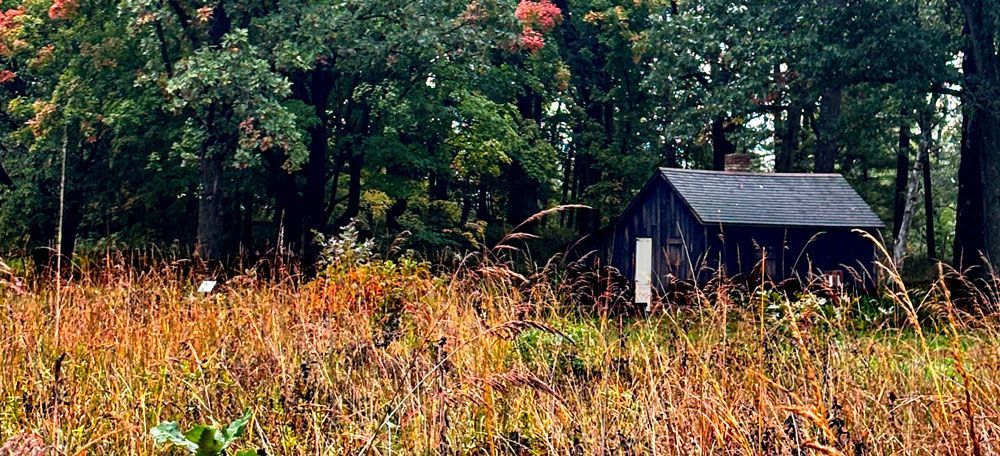
The shack is an old chicken coop that the Leopolds restored as their weekend getaway. It is also where Aldo Leopold got his inspiration to write his famous book, “A Sand County Almanac.” However, I learned from Andy that there isn’t any “place” named “Sand County.” It’s putative. It covers all the counties that reside within the sandy land surrounding the Baraboo area, extending all the way to Wausau — the sandy land the glaciers left behind.
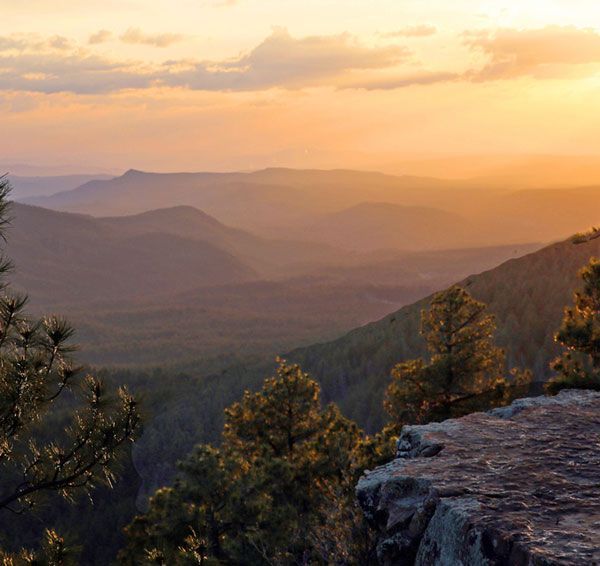
I studied Aldo Leopold as a student of wilderness management and read and reread A Sand County Almanac. In 1909, the Forest Service assigned him as a forest assistant for the Apache National Forest. He spent his early field years patrolling and managing timber, grazing, and wildlife in eastern Arizona’s White Mountains. His chapter on Arizona included a story about the last grizzly bear, named Bigfoot, and how he watched “a fierce green fire die” in the eyes of a wolf, eventually changing his views on wildlife ecology forever.
“I now suspect that just as a deer herd lives in mortal fear of its wolves, so does a mountain live in mortal fear of its deer.”
— Aldo Leopold, “Thinking Like a Mountain,” A Sand County Almanac
In 1911, he earned a promotion and moved north to the Carson National Forest in New Mexico, and in 1922 he proposed The Gila Wilderness Area, which officials officially established on June 3, 1924, protecting over 558,000 acres of the Gila National Forest. People consider him the father of conservation, and they named a wilderness area in New Mexico after him.
Eventually, the Forest Service moved Leopold to Madison with the promise of a job with the Forest Products Lab. The job never materialized. After waiting three years, he quit and took a contract job surveying 14 upper Midwest states. He then wrote a book called “Game Management,” which gained him local prestige and a lot of respect and bought him a position as a professor at the University. It was the beginning of wildlife ecology.
In 1935, Leopold wanted to purchase some hunting land for his family. Through the help of some realtor friends, he found a farm near Baraboo. The house had burned down, and the only standing building was the old chicken coop. He bought 80 acres of wasteland for eight dollars an acre and he and his wife, Estella (from Santa Fe) and his five children; Starker, Luna, Nina, Carl and Estella Jr., fixed up the coop — a red clay floor, a bunkhouse wing and a fireplace, and spent the next ten years coming up almost every weekend. They planted about 3,000 trees per year. Aldo loved all trees; however, he had an affinity for pines. His chapter “Axe in Hand,” in the Almanac explains his thinking, but I gathered he still just loved all trees with all of their benefits.
There is a conservation area on the edge of the University in Madison, and Leopold was the first science adviser. It was after he had bought the farm, and he decided he was going to try the same type of restorative conservation there too. So he traveled throughout southern Wisconsin to find native species, dug them up and brought them back to the farm, and planted them. He created an incredible natural grassland prairie that covers hundreds of acres. However, it requires a tremendous amount of maintenance. The Foundation has a stewardship crew that is constantly working and burning to take care
of it.
In 1948, at 61, Aldo Leopold died suddenly of a heart attack while helping to extinguish a fire at a farmhouse that once existed where the Visitor Center now stands. There is a memorial there, where he died, the actual location pointed out by Estella Jr. who was there that day. It was one week after he had finally found a publisher, Oxford University Press, to publish his book of essays called “A Sand County Almanac.”
The shack is about half a mile down the road from the visitor center. We parked by a railed fence and hiked down a trail shadowed by towering pines and other trees. The Leopolds planted everything that surrounded us, except an old apple tree that they believe predates them. Estella Jr. mentions it in her book “Stories from the Leopold Shack,” stating that it was planted by previous owners around the late 1800s.
The shack sits solitary under a tall white pine that may or may not brave another storm. There is a sand-point hand pump Leopold installed, a white side-shuttered window, white door and plain rustic window on the south side of the shanty, and a rustic Bahama shuttered window on the east side. According to Estella Jr., the shack was built during the Great Depression, so they used recycled materials. A small shed near the shack provided boards to build the bunkhouse wing, and they ventured into Madison to find the old windows and door. They even walked up and down the banks of the river to scout for beams and boards. Leopold’s son Starkey built the “privy,” an outhouse that they called the “Parthenon.”
Andy recommended I reread “Marshland Elegy,” a chapter in Sand County Almanac that Leopold wrote about the cranes. During Leopold’s time there were only a couple dozen mating pairs, and he believed they would become extinct. Today, however, there are over one hundred thousand mating pairs. In fact, every November, the sandhill cranes congregate behind Leopold’s shack, about 10 to 15 thousand of them. Radtke tells me that every evening the cranes congregate on the banks of the Wisconsin River, and in the morning fly back out to the farm fields and feed all day. Then one day, they all rise up and fly south. They hold tours from November to mid-December every night in blinds to watch the cranes. They also co-host with the International Crane Foundation, the Great Midwest Crane Festival, which takes place this year on November 14 and 15.
George Archibald co-founded the International Crane Foundation, located a few miles from the Aldo Leopold Foundation, with one crane. He was a graduate student who imprinted on a whooping crane, one of the rarest cranes on Earth. Archibald spent three years with the highly endangered whooping crane named Tex, acting as a male crane — walking, calling, dancing — to shift her into reproductive condition. Through his dedication and the use of artificial insemination, Tex eventually laid a fertile egg. Archibald turned 80 this year. Currently, he heads a World Conservation Union commission on crane survival.
The focus of the Aldo Leopold Foundation is to restore and maintain habitat for grassland birds and to create a land ethics philosophy. They are witnessing some birds that are returning, such as the Henslow’s sparrow and even the red-headed woodpecker. There are also over six square miles of surrounding wildlife habitat called the Leopold-Pines Conservation Area, formed through a collaboration between Aldo’s daughter, Nina Leopold Bradley and Phillip Pines. The Pines live across the river from the shack. The Pines Family and the Foundation cooperatively manage it with the goal of restoring and maintaining a special habitat along the Wisconsin River called swamp white oak savanna.
My oldest son, Jesse, traveled with me to see the shack. I’m sure he wondered why I was so excited to see a ramshackle shanty sitting among a desolate savanna prairie. But to me, it was more than that. It’s a place of inspiration, a creation of a natural world where birds and animals can find restoration and peace. As Henry David Thoreau states, “In wildness is the preservation of the world,” I truly believe it is so. While Thoreau simply observed and wrote, Leopold took action by developing natural resources, safeguarding existing ones, and then documenting his experiences. Aldo Leopold’s vision of conservation and wildlife ecology has set the stage for us all to believe in land ethics. My visit to the Shack made it real. Even Jesse walked away in awe of a man who changed the world of conservation.
Read “A Sand County Almanac” by Aldo Leopold. His writing has endured for decades and will continue to inspire future conservationists.
On the first Thursday of every month, the Aldo Leopold Foundation holds a free podcast called “Land Ethic Live.” They bring in conservation leaders and writers and visit with them for an hour or more. During the second week in March, they hold three podcasts in a row because it is Aldo Leopold Week, which was declared by both the Governor of Wisconsin and the Governor of Iowa.
Go to www.aldoleopold.org
(sign up for their newsletter)
Facebook: Aldo Leopold Foundation
Instagram: aldoleopoldfoundation
Go to OutdoorsSW.com for more photos.