Article and photos by E. Alcumbrac
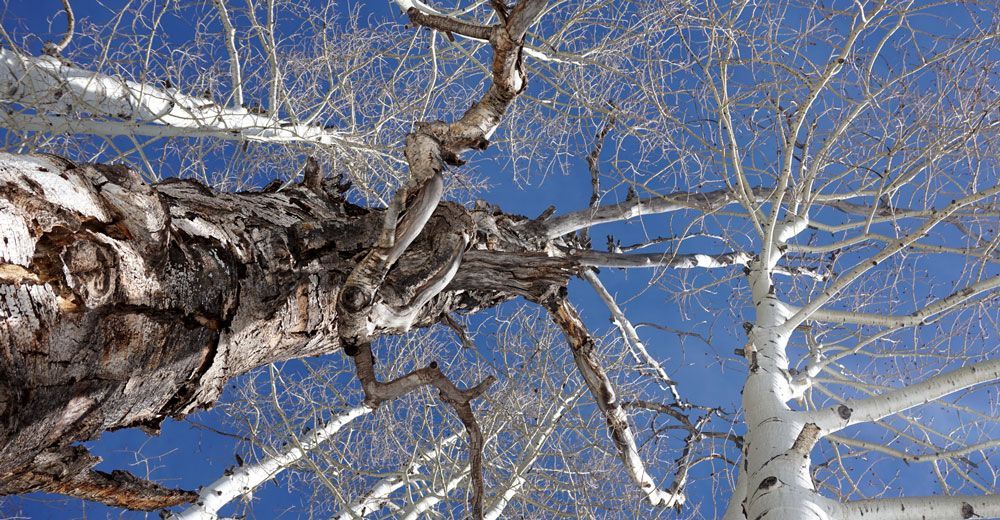
What do we see when we look up? In the White Mountains, we are surrounded by towering giants. We smaller creatures scurry between them. From our perspective, we observe only their legs — robust and steady — appearing still in contrast to the rapid pace of our lives. If we examine the lines on their trunks — like wrinkles formed over a lifespan much longer than our own — we can trace them up to the youngest branches. These extremities are flexible and animated, waving gently in the wind. The scene is a turquoise sky of dwindling branches reaching into the vivid blue expanse.
“The sky constantly changes, but the trees remain fixed to the same ground I stand. In this moment’s stillness, we are sharing the same sky — a scene that will never be exactly like
this ever again.”
— E. Alcumbrac
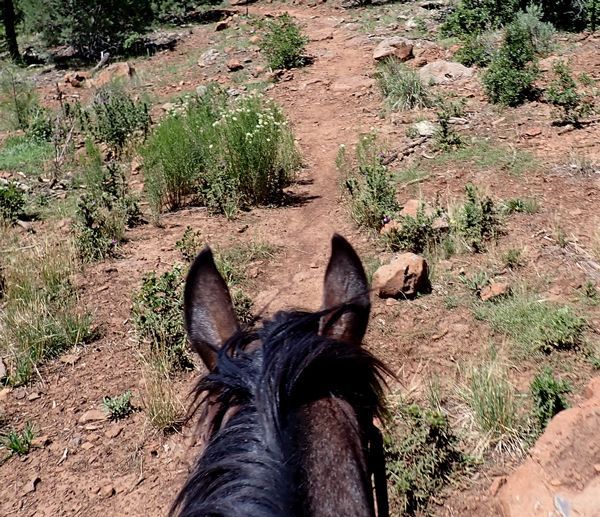
On any given day, I grab my pack and my camera, lace up my hiking boots, and head into the forest. I keep my eyes down — the terrain here can be perilous and demands focus. Resembling patina on copper, lichen adorns the jagged edges of basalt rock. Fallen pine needles blanket the ground; each step releases the earthy aroma of petrichor — a unique scent shaped by the relationship between minerals, detritivores, and the surrounding trees. While being careful not to twist an ankle or crush a young sapling, there is indeed beauty to behold while looking down.
Feeling the sun’s warmth on my face, watching clouds drift slowly across the sky, or searching for patterns among the stars — all these experiences inspire one simple gesture: looking up. It feels entirely human to look up at the heavens and lose myself in thought. It is an infinite direction, and with it, endless possibilities. When I gaze upwards, I cannot help but feel small, and the challenges I face in my day-to-day life become smaller with me. The sky constantly changes, but the trees remain fixed to the same ground I stand. In this moment’s stillness, we are sharing the same sky — a scene that will never be exactly like this ever again.
When I photograph a tree, I treat the experience less like nature documentation and more like a portrait. I try to capture personality emphasized by light and color. Taking a portrait of a human being from such a low angle would make for a very unflattering picture. However, I think it suits the trees quite well. The perspective is that of a child looking up at a parent. Under the bow of a tree I feel safe and protected by something much larger and greater than me. As a silent observer, I witness the slow conversations amongst these giants—they exist in a realm beyond my reach, and much of what they have to say, quite literally, goes over my head.
The personification of a tree can breathe life into what is too easily disregarded as an inanimate object. I choose to appreciate them, express my gratitude to them, or even go as far as to love them. When I wake up on a cold morning and look out my window, it is the glowing treetops bathed in first light of the sun that are the refuge for birds and squirrels trying to warm up after the long night. When I watch an Arizona sunset — which is, without a doubt, the most beautiful in the world — I wish I could grow as tall as the trees. Then I could see the sun in the tapestry of colors across the sky a moment longer, just like they do. The trees are far more than wood and leaves; they can be our teachers should we ever choose to look up and learn how these beings embody harmony with their surroundings.