
Spring is a Good Time for Routine and Preventative Maintenance
By Allanna Jackson
As spring arrived in the White Mountains, the weather in March confused itself with May, bouncing over 50 degrees between overnight lows below freezing and daytime highs near 80. The dry weather was perfect for trail riding, but my horse trailer was out of service for most of the month, awaiting parts. The horses didn’t mind. They were content to stroll along the familiar trails close to home. Most years the weather in March isn’t suitable for hauling the horses anywhere, anyway. By the end of the month, my trailer was back in service, ready to take the horses on an outing at the next available opportunity.
When the weather hit 100 degrees down in the desert in the last week of March, we had a surge of visitors eager to escape to their favorite summer-time activities in the high country. The mountains were still in what we call “shoulder season” — the time of year when the permanent residents usually have the mountains to ourselves because there isn’t enough snow left for the winter sports, the highways and campgrounds are still closed for the season, and the Arizona Game and Fish Department (AZGFD) has not yet started stocking fish in the lakes. Spring is a good time to do the planning and preparation for the summer recreational season.
Today, much of our outdoor recreation involves trailers. We use trailers to haul many of our outdoor toys into the forest: boats, bicycles, camping gear, UTV and ATVs, horses, and RVs. Every day on White Mountain Boulevard you’ll see everything from single axle boat trailers to triple axle travel trailers as large and as expensive as a Tiny home or single-wide modular home, flat-bed trailers, stock trailers, horse trailers with living quarters and without, dump trailers, construction trailers, equipment haulers, specialized trailers, general-purpose trailers and more. It’s easy to take recreational trailers that are used only a few times a year for granted. After all, the lights worked the last time the trailer was used; the tires are so new they have no wear on the tread, and the wheel bearings were re-packed a few years ago.
Surprise! Trailer wiring is notorious for developing loose connections that are hard to find and harder to fix, even when rodents don’t use the wires for bedding or dinner while the trailer is in storage. Light bulbs fail randomly. The date coding on the sidewall of those “new” tires may reveal they are 10, 15, or more years old, which means a tire store will refuse to repair them if the invisible environmental degradation results in a flat. A few years too easily turn into a dozen years when relying on memory to keep track of when a trailer’s wheel bearings were serviced. Recommendations about how often trailer wheel bearings need to be serviced vary widely, so consult your favorite mechanic. Sitting parked is harder on trailer wiring, tires, and wheel bearings than continuous use.
The life-expectancy of trailer wheel bearings is not as predictable as we could wish. My first experience with a trailer wheel bearing failure occurred only two-and-a-half months and 2,500 miles after the trailer had been fully serviced in preparation for a trip from Arizona to Alberta, Canada. Back home, the shop that had done the trailer service three months earlier blamed the wheel-bearing failure on a microscopic manufacturing defect in the bearing. It’s also possible the southern Alberta “drought” that rained on me for the first six days and 700 miles of the return trip contributed to the bearing failure and a combination of cold water from mud puddles splashing on wheels that were warm from 200+ miles of travel on water-logged highways that day. Whatever the cause, the following year, and only 1,000 miles later, the damage from that initial wheel bearing failure destroyed another wheel bearing along with the trailer axle that had been damaged by the first wheel bearing failure. Déjà vu, my fear that this year’s trailer wheel bearing failure had damaged the axle again proved to be correct. A new wheel bearing barely survived the 13-mile trip to a local shop to replace the front axle that wheel bearing failures had again destroyed. It was a good thing I didn’t try taking the horses anywhere in March!
Boat trailers are especially prone to wheel bearing failure and axle damage when the grease in the wheel bearing, which has gotten nicely warm doing its job while rolling down the highway, is suddenly immersed in cold lake water when the boat is launched. Because this problem is so common, manufacturers now design special marine wheel bearing grease for boat trailer usage.
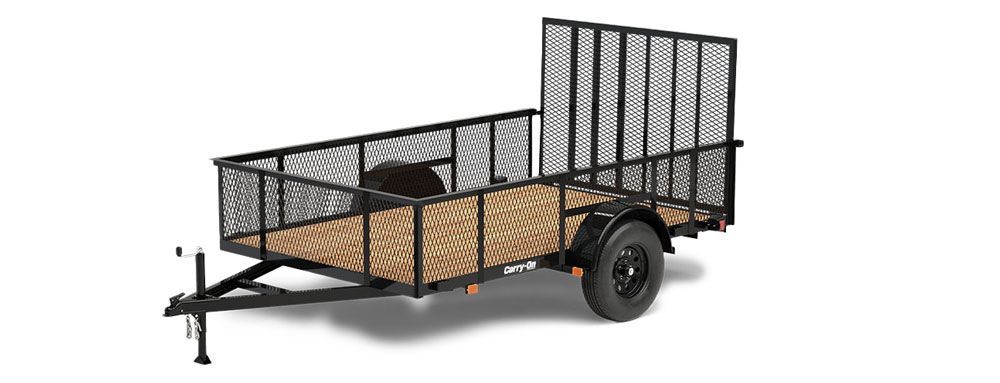
Trailers deceptively appear simple: they consist of a frame and hitch, axles, wheels and tires, brakes (on larger trailers), and wiring for lights to communicate with other drivers. A platform or box, suited to the trailer’s purpose, tops these components. This simplicity means that every component of a trailer is critical. A failure of any part easily renders the entire system inoperable. We can’t build a fail-proof trailer. Though preventative trailer maintenance isn’t a 100% guarantee, it reduces the risk of catastrophic failures in inconvenient or dangerous ways and places. A trailer that is basically in good shape is more likely to survive unpredictable problems with minimal damage. Spring is a good time to have routine and preventative maintenance done on trailers and all the other outdoor toys so they don’t leave us stranded, or worse, a long way from help. With the trailer ready to roll, a quick pre-trip inspection is all that is necessary when departure day comes for that carefully planned trip to the great outdoors.
Note: Keep chains from dragging to prevent a wildfire.