The People Who Shaped Arizona's History
By Annemarie Eveland
Photos and Stories submitted by David Grassé, author, historian
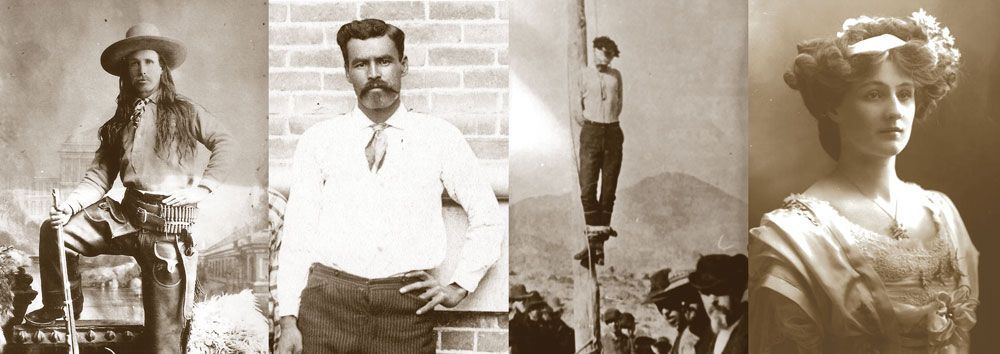
Author David Grassé, while attending Arizona State University in Tucson, felt impressed as he learned about the people who shaped Arizona’s history. One was Commodore Perry Owens. He wrote about Commodore Perry Owens’ gunfight at Holbrook in his first book. This gunfight had impressive violence. Owens took down four men. Grassé was so intrigued that he wrote a biography of him, and his college instructor encouraged him to make it into a book. So, Grassé did a lot of thorough research, which took about three years to finish writing.
Perry, when young, was in a gang in Oklahoma and sold whiskey. Because of his lucrative venture, he served six months in jail. Then Perry came to Arizona and became a foreman at an established ranch. He didn’t care for politics, but he was especially good with a rifle. His reputation as a marksman with a rifle led him to be hired as the sheriff of Apache-Navajo County.
When the Pleasant Valley feud began, Graham turned state’s evidence against Tewkesbury for rustling; things escalated from there. After the Holbrook gunfight, Apache country authorities brought Owens before the Justice of the Peace. They determined he was right to shoot and kill as they came at him with guns, as told in The Bisbee Massacre.
We’ve likely all heard the legends surrounding the unrest during that time. Once, when five cowboys were robbing the general store, it escalated into deaths. Their method was to get into the store while two men stayed outside and shot anybody that came close to the store. The cowboys killed four people and wounded one. A man came out of the store and they shouted at him, “Go back in!” The man said, “I’m not going back in, I just came out.” So, they shot him too.
It was determined that it’d probably take a month to catch the guys who were robbing the store. Then someone remembered there was a man named John Heath, and he came into town with the guys who robbed the store and killed the people. So, they looked for him, caught him, and arrested him. They also caught the other five bandits. They were all tried separately.
John Heath, as a youngster, had masterminded several projects. He wanted to build businesses. As a man, he started a dance hall and a prostitution business. However, they arrested him. During his arrest, he claimed he was not with them. He explained he rode into town with them because of the threats of Apache raids on the route he took.
Grassé made the comment to me that, “The more I researched, the more I realized he was just erroneously assumed to be part of the gang who robbed the store.”
So, fortunately for John Heath, the citizens just put him in jail. Unfortunately, soon after, they went into that jail, dragged him outside and lynched him. (I guess that was the way of the wild west, in-justice?)
Grassé also wrote about Augustine Chacon who was a notorious Hispanic Arizona outlaw. Newspapers ran an article about his escape from jail. A court tried and convicted him for a murder he did not commit, but he escaped from the Solomonville jail and fled to Mexico, where he disappeared for almost five years. People blamed Chacon for all the bad stuff that happened in and around Arizona during that time, if the perpetrator was Hispanic. The stories of his bad deeds kept growing in colorful and outrageous tales. Once, Chacon went to Mexico for five years and joined the Mexican army. In 1903, Billy Stiles and Burt Alvord, former lawmen, made a deal with Chacon. Since a murder warrant was still out for him, they convinced Chacon to steal horses with them. They then capture Chacon, and he gets jailed again and then hung.
…..”AND WHAT ABOUT THE WOMEN OF THE WEST?” I asked.
In France there was an English actress named Edna Loftus. She was a very popular actress in French musical cabarets. (Grassé mentioned he had many picture postcards of her.) She married an American jockey while riding in France. But later, she divorced him and came to New York to restart her career. She meets Rheinstrom, a millionaire’s son, and his mother doesn’t like him marrying a Catholic girl. The son was philosophical, and his entire premise was “All we need is love!”
Edna and her husband started a chicken ranch. It sounds incredible, but it is no surprise when it fails within six months. The next misanthrope finds them in San Francisco. Rheinstrom goes around and begins taking drugs and drinking heavily. His family is sending stipends; but it is not enough. He gets arrested twice; his family sends a lawyer out to get him out of jail, and then he is committed to a mental institution, where he died.
To make matters worse, his wife, Edna, couldn’t get a job. She tried to kill herself twice and eventually ended up in a brothel, then got arrested for prostitution. The public blames her for all the stuff that had been happening. She had American citizenship, but unfortunately, she was still called an undesirable person and died in the county hospital. She was buried in Forest Lawn in Colma, California. Her “low-life” friends got her a casket and a plot in a Holy Hope cemetery, but there was no headstone for her.
About five or six years ago, when Grassé visited her grave site, he felt her life was so tragic, he bought her a headstone and had it placed on her grave.
The Red Light District of Tucson no longer exists. There is not even a plaque on the former streets. But there is the history of that whole era and the people who lived it are in Grassé’s new book, Red Light Districts of Tucson. For example, the “Maiden Lane” started in the 1860s; 1870 is where they found the first references. They were called Cribs. — it had a bed, a window and a door. Guys would knock on the door. It took place between 1870 and 1918.
In 1893, the businesses on the streets of Congress and Stone were legitimate businesses. They didn’t want bad business “in their face” and shooed them out. Prostitution and its subsidiaries rushed out to all parts of the city and disrupted all. In 1896, the City Council had a “Red Light District Gay Alley” (named for Joesph Gay, an early pioneer). There were the Cribs again; but on one end was a two-story brothel, owned by Eva Blanchard. Blanchard, who got herself a new name, had lived in Ohio with a family, went to a convent school in New York, then became a prostitute in Boston. Next, she disappears for ten years and then reappears in Arizona as a Madam; owning the only brothel in Tucson with six girls. Eva invested in property in Tucson.
She married as Annie Sullivan Wiley to Joe Wiley, a professional roulette gambler. She donated to both the church and the schools because she was Irish and born a Catholic and she donated a building to the Arizona Daily Star newspaper. Her gravestone in Holy Hope Cemetery reads “Annie Sullivan Wiley (A Pioneer).”
When they were rebuilding St. Augustine’s Church on Stone Avenue in 1897, she approached the Bishop and asked if she could put in “the name of my Sullivan family.” The Bishop said, “Absolutely NO!” Later, when the building funds were meager, he sent for Annie and said, “We will take the money.” This time she emphatically said, “NO!”
Grassé is the Creative Director for THE TERRITORIAL TROUPERS,who he started historial reenactments with while still living in Tucson. He was a state librarian for five years, then moved up to be at the Payson Library. The Territorial Troupers perform stunt work, reenactments, gun fights, and accurately writing scripts with historical accuracy depicting the Old West. He met Kenny, the head of the group, nine years ago. They meet regularly on the first Tuesday each month, at the library and the meetings are open to public. He added, “You can always reach me at the Payson library, and you are welcome to join our small, wonderful, and authentic group meetings— a place where our Arizona history comes alive.”
Grassé has five books out, including his newest, Red-Light District of Tucson.
Book titles by David Grasse:
The True, Untold Story of
Commodore Perry Owens
The Bisbee Massacre:Robbery,
Murder+Retribution in the AZ Territory, 1883-84
The True Story of the Notorious Arizona
Outlaw Augustine Chacon
From the Footlights to the Tenderloin:
The Tragic Life of Actress Edna Loftus
The Red Light Districts of Tucson,
1870-1918 (new book)