The Amazing Story of Lichen
Article and photos
by Carol Godwin, Cycle Mania
Spring is the season of change, and we celebrate the unveiling of new leaves, flowers that spring open from bare branches overnight, and the new blades of green grass that suddenly replace the old brown grass that was there just a few days ago. Easter celebrates the reawakening of life after a season of dormancy and…the other day I heard the zzzz of the first hummingbird of the season! Life is amazing, and it’s past the time to get out for a nature walk to appreciate the miraculous tapestry of life all around us.
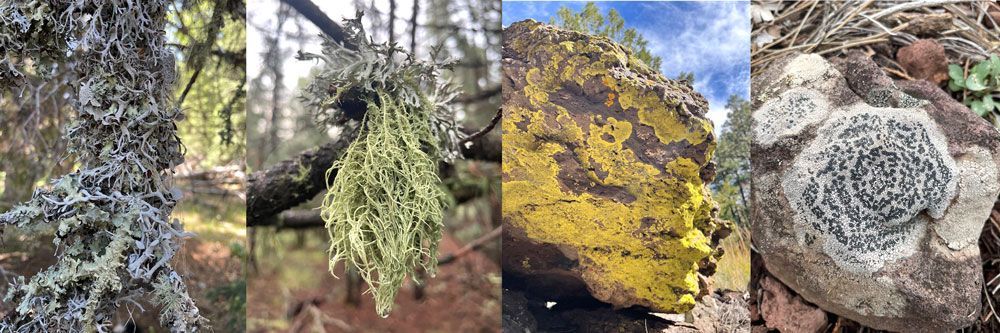
Yes, there are plenty of obvious signs of new, shiny life surrounding us in spring, but you know what I appreciate and admire all year-round? Lichen. Yes, that immobile, crusty stuff found on rocks and tree bark and just about anything else that stays still for decades. Lichen is the definition of rock-steady in a changing world. Lichen is always there in its vibrant colors, ranging from reds and oranges to nearly black, to every shade of green imaginable, and even white. Lichens can also, but rarely, come in bright blue!
Every color in the visible and non-visible spectrum can be found in lichens across the world, and…did you know you can have some fun in the dark with a UV flashlight on lichen? Many lichens will exhibit phosphorescence when viewed with a UV light, and you might just find a phosphorescent scorpion, millipede or fungus glowing in the dark too. Lichen shows its true colors brilliantly after a rain or under snowmelt, as the fungal cell walls become more translucent, revealing the colorful algae or cyanobacteria within. Freezing temperatures, broiling sunlight absorbed by dark rocks, wind, rain, hail…you name it, lichen can withstand it, as it has for millions of years. What is special about lichen that allows it to come in so many hues and to survive so many conditions that would defeat most other organisms? Within lichen lies a tale of the very evolution of life on Earth, and it is fascinating to think about.
Lichen is not a plant, not a fungus, a protist, a bacterium, nor, of course, is it an animal. Lichen does not fit neatly into any of the five kingdoms of modern living things, into which we have divided life on Earth, and is a great example of what we might find as extraterrestrial life on other planets. In fact, lichen has been taken to space on the ISS, attached to the exterior of the space station for 18 months in a subzero vacuum and had no problem recovering and resuming photosynthesis when returned to Earth!
Lichen is an amazing symbiosis of cyanobacteria, algae and fungus, all dependent on one another for survival in a changing and often harsh world. Cyanobacteria were among the first living things to colonize the early Earth, arising in the prehistoric oceans over 3.5 billion years ago. Cyanobacteria evolved the chemical process of photosynthesis and could use nearly the entire light spectrum for this process. It dominated the upper layers of the marine environment where they could access sunlight and would have made the water appear purple because they commonly reflected red and blue light and could utilize green light.
Algae evolved from the endosymbiosis of cyanobacteria and eukaryotic cells; the cyanobacteria containing the photosynthetic energy-providing chloroplasts we see in all plants today. Algae were free-floating in the ocean, and their photosynthetic mechanism specialized in utilizing the wavelengths of light, blue and red, that were being reflected from and passed through the upper cyanobacteria layer. Modern plants are the variety of green hues we see in most plants today, purely because of prehistoric marine competition for light with the earlier cyanobacteria. Both cyanobacteria and algae are water-dependent, so how does this all fit together in the story of lichen, a living thing that most definitely is not a water-dependent species, in fact, a species that appears nearly water-independent, and can survive months with no water whatsoever? Well, we are getting to that part next.
At several points in time from between six and four million years ago, and locations across the evolving landscapes of life on earth, cyanobacteria and/or algae were living in cooperation with early fungi; the fungi surrounding the smaller organisms with a protective coating and the photosynthesizing organisms providing food for the heterotrophic fungi which previously had relied on decaying matter for sustenance. Modern lichen shows up commonly in the fossil record about four million years ago, quite a bit after modern plants colonized the terrestrial landscape.
Keeping the photosynthetic organisms captive provided the fungi with a reliable, steady food source and allowed them to colonize previously out-of-reach habitats such as exposed rock surfaces. It is debated whether the photosynthetic captives got much benefit from their relationship with fungi, but the prevailing theory says that the fungi provide protection and a survivable environment for the previously free-floating aquatic algae and bacteria and allowed them, too, to colonize previously unavailable niches in the environment.
Lichens release acids onto the rocks and literally etch themselves in place on rock surfaces. You can see how large colonies of lichen have begun at a central point in the colony and radiated outwards in nearly perfect circles as they reproduce and move equally in all directions from the original colonizing parent organism. I frequently lug especially nice lichen-covered rocks home from hikes and noticed that when sprayed with water, a brown powder runs out, floating on the water. This is not dirt, but instead packets called soredia, which contain microscopic fragments of both the fungus and its photosynthetic partner(s). The soredia are dispersed by wind or rain and help move the lichen to other areas. The mechanical spreading of lichen colonies across rock faces is accomplished by asexual reproduction, and lichen has at least a dozen other ways to reproduce itself that I needn’t describe here. Needless to say, lichen has no trouble reproducing itself in whatever environmental conditions it finds itself!
Lichen comes in three main growth forms depending on its stage of development on the surface it is colonizing. The most common form is the crustose growth stage, which looks like spray paint on whatever substrate surface, and is tightly bound to the rock surface and is nearly unremovable. The next growth form that develops after the lichen is well established on the surface is the foliose form, which looks like tiny flaky sections that are easy to peel away from their crustose bases (please don’t). These flakes are flat with upwardly curling edges and provide more surface area for photosynthesis. These loose flakes break off easily, and each can form a new colony if it lands in an appropriate location. The final form, which is exponentially more common on tree bark, is the fruticose lichen, which many call Spanish moss. It is three-dimensional and looks like hanging strands or hairs, each of which can break off and form new colonies.
I admire the tenacity of these tiny organisms and their ability to colonize around corners, past cracks in a rock, and across large expanses of exposed rock face. The only place you won’t find lichen on a rock is on the bottom of it because the lichen relies on sunlight to power its captive photosynthesizing algae and/or bacteria. So, when I’m out hiking, I keep an eye out for lichen, and if I see an overturned rock; I flip it back to its licheny upside. Why not? That lichen has been there progressing across that rock for thousands, if not millions of years, and if I can help it last another million years by simply flipping its rock back over, why wouldn’t I? We live in a tiny speck of time compared to a lichen, which can live over 10,000 years, with whole colonies quietly, slowly, dissolving rock for millions of years.
The progress of lichen over a rock during our lifetimes is agonizingly slow, but over centuries and millennia, the acids excreted by lichens can cause chemical weathering of rock and help the successionary process of a landscape moving from bare rock to soil to grasses and herbs and then the climax community of larger trees, returning rocks into the rock cycle as sediment in the process. Lichen is an amazing in-your-face example of the evolution of life on earth, the resiliency of life in the face of change, the ability of life to “find a way” no matter the conditions, and the blink-of-an-eye amount if time each one of us has here on Earth compared to the span of time that is the Earth’s existence. Admiring and trying to understand the little things is one way I celebrate the small time I have here, and I’m grateful that I live where there is so much to see and learn about.
Note: A fun activity for kids or kids at heart is to get a piece of lichen-covered bark and wet it down. Wait a few minutes and then look at it with a magnifying glass. The boring lichen will nearly immediately begin to plump up, and an amazing microscopic jungle environment will appear before your eyes with glossy green shoots springing up through the lichen and from between cracks in the bark. What is this amazing green growth? Well, it’s not lichen, but an entirely different organism living in symbiosis with the fungus, algae, and bacteria living together in the lichen.
Here’s a tip: If you hold that piece of wood in your hand, you have an example of every kingdom of living things on earth right there in that small space between your fingers. You’ll learn all about what this is and how it survives in an upcoming article this spring about the incredible environment we call home. Life is awesome; live it well. Happy Spring Everyone!