Taking on more challenging activities
Article & Photos By Rob Bettaso
If, in your lifetime, you’ve worked and/or played hard enough, long enough, you might, unfortunately, eventually suffer from some kind of joint pain. As just one example, during my career as a fisheries biologist, I faced my share of occupational hazards; one of which came from routinely slipping and sliding on scummy stream bottoms while dragging seine nets and using other aquatic gear-types to study various fish populations. In my last year as a professional biologist, a doctor diagnosed minor meniscus damage in my right knee. He also added that I had osteoarthritis, which he felt compelled to mention was due to “having too many birthdays” (his clever way of telling me I was old).
The doc recommended arthroscopic surgery, which, for a variety of reasons, I wanted to avoid. At first, I opted to ask my supervisor (at that time; I was working a temporary contract with the Fish and Wildlife Service) if I could be the field data person so that I could let my sore knee rest. That helped a bit, but even as the data-taker, I still had to hike, and so when the season wound down, I decided not to renew my contract and instead, I settled into full-time retirement.
For a while, I stopped any unnecessary activity that might aggravate my knees. Once I felt better, I slowly and gently resumed hiking, but quickly realized that anytime I had to descend a steep and sustained grade, my right knee would rebel, and I would be laid-up again for a period of time. Desperate, I tried my own approach to physical therapy (PT). If hiking was tricky, I would get exercise and enjoy the outdoors by taking easy bike rides along the dirt roads around town. Perhaps because gravity plays less of a role in biking than in hiking (or, put another way, there is less of a pounding-type of impact to one’s legs), my knees did not object to cycling (I have road- and trail-biked most of my life anyway, and it has never caused any knee pains).
Because my initial positive results emboldened me, I wanted to diversify my PT regimen to include some type of activity that would be good for balance and flexibility. As such, I brought home a Tai Chi video from the library and began doing that in the evenings. That also seemed to help, even if I did feel rather foolish performing the various maneuvers.
As the warm season ended and the cold season began, biking became too chilly for my liking. Fortunately, by that time, I discovered I could hike moderate grades and distances if I was extra mindful of the terrain (e.g. rocks, roots, and unexpected dips/holes) — thereby avoiding stumbles and other sorts of missteps. When some snow finally fell, I was excited to see how cross-country skiing would affect my recovering knee. I was optimistic since, in the past, cross-country skiing had never caused me any joint pain. We had a decent amount of snowfall that year, and I got out skiing fairly often. The pushing/gliding nature of skiing not only didn’t bother my knees in any way, it also helped strengthen the supporting muscles, which may have accelerated my injured knee’s recovery.
Over the several years that have passed since those days, my self-designed PT seems to have proved sound,* and I have steadily taken more challenging hikes and basically engage in any other type of outdoor activity (keeping in mind, that as I approach 70, it’s not like I’m going to take-up something like sky-diving or power-lifting). I did, several years back, add to my PT a trick that I accidentally stumbled upon (so to speak), and that very much seems to have helped keep both knees in good working order: namely, I find that if I lay supine upon a level, flat surface (the floor of any room in my house, or even my bed), I can use the foot of my left leg to pin down and hold steady my right foot; then, if I slightly lift and partially rotate my right leg, I can get my right knee to resoundingly pop; next, I reverse the operation and achieve the same effect with my other knee. For me, I swear by this manipulation as it somehow seems to perform a vital adjustment to the knees that helps to relieve joint-compression. Besides, it simply feels (and even sounds) wonderful to have my knees make a loud “crack” as they slide into perfect alignment.
This winter (2025/2026), we’ve ridden a roller-coaster, weather-wise. One week we’ll have rain, another utter dryness, the following week we’ll get some snow. During all the scattered, small storms that have brought us sufficient snow, I have gotten out to go snow-hiking and cross-country skiing. When I wasn’t out solo, my most frequent snow hiking/skiing companion was my friend Anne. Both Anne and her husband Dan spent much of their lives in the upper Midwest, so they are no strangers to winter weather or winter sports. Unlike me, they seem impervious to the cold. Personally, I’ve never cared for temperatures below 70 degrees Fahrenheit, but I have always tried to make the best of frigid winters by playing in the snow (at least when it falls).
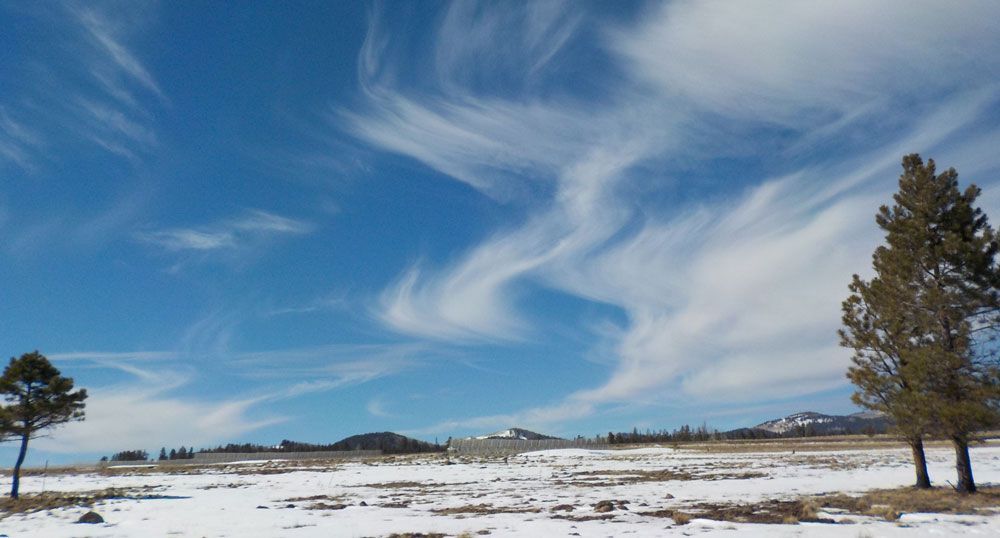
In mid- to late February of this year, we had several days that were suitable for fun in the snow. One spot that is a quick and easy place to get out in the snow is along a dirt Forest Service road which is closed to cars and trucks but open to snow-mobiles, skiers, and snow-hikers. Happily, this road is also near Anne and Dan’s house, so it made for a few quick and convenient jaunts on a few different occasions. And, while I don’t particularly wish to ski near loud and smelly snow-mobiles, I must say that for some snow conditions, it is much easier to ski in the tracks left by snow-mobiles.
Once the snow conditions deteriorated in town, we would head to elevations exceeding 8000 feet, where the snow lasts much longer, especially in the more deeply wooded areas where the sunshine makes less contact with the forest’s snowy floor. I guess because our season has mostly been a warm one; we didn’t encounter very many other people skiing in the high country; perhaps because they erroneously thought the conditions up high would become as sloppy as they had quickly become down lower.
I also wondered if wildlife were also sticking to the lower elevations, as it has seemed like both deer and elk have been noticeably more numerous in and around town this winter. On one particular outing, when I was out hiking in slushy snow along a quiet and seldom-used dirt road, I was especially thrilled to have an up-close and fairly prolonged look at a bobcat. I had been walking slowly and stopping frequently while observing the standard winter birds, when suddenly, I noticed not more than 30 paces ahead, a feline casually crossing the road while she faced into the sun and padded toward the Apache lands. Naturally, I stopped and stood stock-still while I slowly raised my binoculars to get a better look. Sure enough, it was a tawny/rufous colored bobcat complete with namesake bobbed tail, tufted jowl fur, and eye-spots on the backsides of her prick-up ears.
Since I don’t see bobcats very often, her image has stayed in my mind throughout these dwindling days of winter. And every time I’m immersed in the white world of our higher elevations, I keep hoping that by moving stealthily through the snow-muffled landscape, I (or preferably, we) will be lucky enough to closely (but safely) monitor some infrequently seen critter such as a lion, a wolf, or even an ermine. But then again, it is also quite gratifying to simply be outdoors enjoying the breath-taking winter scenery while also being in reasonably good health and with good friends. In fact, it kind of reminds me of a Bette Davis line from one of her many legendary films: “Why ask for the moon, when we already have
the stars….”