Be prepared to see some spooky characters this Halloween
By Dan Groebner
It’s the Halloween season, so be prepared to see some spooky characters roaming our White Mountain streets and alleyways. Ghosts and vampires are some of the most popular costumes over time, as they exemplify some of the scariest inhabitants of our nocturnal world, possessing adaptations humans can only dream of, like passing through walls or flying through the air.
The fear of the unknown and unimaginable seems to be a visceral reaction from most people when faced with experiences in the dark. Humans lack the adaptations to survive well after the sun goes down, which may be the root of many cultural practices of Native Americans and some deeply held fears of all modern humans to a degree.
Early humans had to admit that at night, the predators could see them, but they couldn’t see the predators. Humans could be heard by the nocturnal hunters, but we didn’t have acute enough senses to avoid being hunted and ambushed. So many creatures of the night are vilified as demons and bogeymen to help teach the younger generations how to avoid becoming a meal for a monster.
Some Native American tribes consider the night darkness as the domain of unknown mysterious beings and not a natural place for humans to feel comfortable. Spoiler alert to Native Americans following traditional practices that this article will discuss owls. We apologize if we offend anybody who believes that owls represent a bad omen, often including the death of someone. However, some modern cultures see owls as wise and knowledgeable, possibly because their large eyes represent extra-human insight and intuition.
Early folklore describes how all animals were only active during the day, but then the predatory beasts took to the nocturnal hours. That included many carnivorous mammals, including bats, but hardly any birds. One notable bird exception is most members of the owl family.
So what makes owls and their nocturnal neighbors so creepy? Obviously, animals of the evening have their own special adaptations that humans don’t. The one sense that probably makes humans the most nervous at night is the lack of night vision.
We are so dependent on our vision during the day that panic can quickly set in when it’s gone. We are finely adapted to see colors and details with good light, but lack the large lens, massive numbers of rod nerve endings and reflective layer on the inner side of our eyes to gather, amplify and interpret the extremely small numbers of light waves and photons bouncing around at night. Owls, and other nocturnal creatures, possess all of these tools to see better, usually at only the small cost of not seeing colors that well.
Owls also beat humans in the hearing category, but not how you might think. They can famously hear fainter sounds at greater distances, but they also have the ability to triangulate or locate the exact source of the sound. Triangulating a mouse requires incredibly fast and precise brain processing of the sound signals coming into each ear and figuring out which ear heard the sound first and by how much. If they cock their heads sideways or otherwise, it’s just getting another independent triangulation on the mouse. Sometimes they don’t even have to move their heads at all, as their ear openings on each side are not symmetrical; one ear is higher and more forward than the other ear.
Owls can also use their facial feathers to funnel faint sounds towards their ears, as many have a feather arrangement called a facial disk that acts like a DirecTV satellite dish, but much better looking.
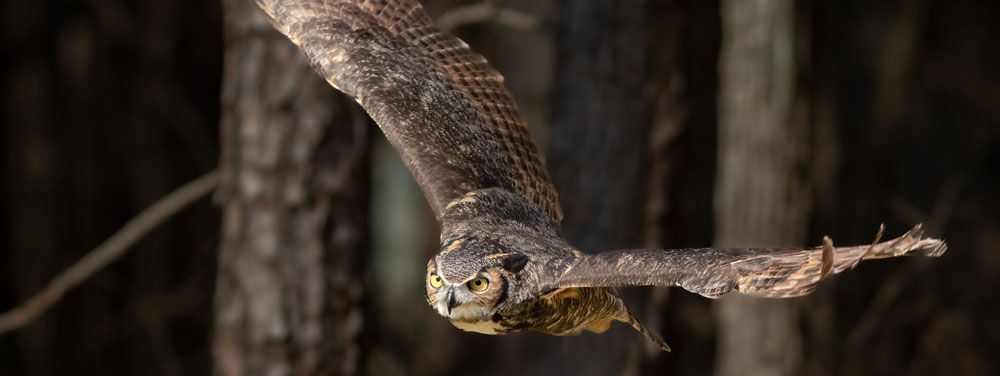
Even if we had the sensitivity of an owl’s hearing, we would never hear one coming if she decided to stoop on us and rake her talons through a part in our hair because we got too close to her nest. And that’s not because most of us talk too much. It’s because the leading edge of an owl’s wing grows serrations that disrupt the airflow over the wing to creates silent flight, especially as they glide down from a perch high in a tree. Modern aircraft are using similar structures to increase efficiency and reduce vortex turbulence.
Owls also own the creepy habit of vomiting every time they eat (almost). But it works for them! It turns out that this is a very productive and streamlined digestive routine. Owls can catch many prey animals like mice and only digest the most nutritious parts that are easiest since they have relatively weak stomach digestive juices.
After allowing the high-octane parts of the mouse to pass out of the stomach for more processing, the undigested bones in the stomach are all wrapped up in undigested fur and vomited in a nice neat little package that biologists term an “owl pellet”. In contrast, a deer, elk, or rabbit “pellet” exits the other end of the digestive tract. Dissecting an owl pellet (available commercially!) and identifying the past owner of the bones embedded is the least smelly and most sanitary method to study what owls eat.
So, is there more than just the great horned owl that lives in the White Mountains? Sometimes referred to as the “horned owl” because of the feather tufts on its head where horns would erupt, this carnivorous raptor can adapt to eating almost any prey animal, even close to its own size. So that means you can find them everywhere from the deserts to the spruce-fir forests.
A smaller impersonator of the great horned owl is the long-eared owl, which looks similar but is much smaller and has a different call. Based on its appearance, the barn owl also has the spooky alias of the “ghost-faced owl”. However, based on its call, it should be termed the screech owl, as it emits a harsh and sometimes raspy screaming screech. Most Hollywood movies use a great horned owl’s hoot to lip-sync the ghostly-looking barn owl. The spotted owl is almost as large as a great horned owl, but prefers less disturbed habitat, including remote canyons and older stands of trees.
There are actually owls called screech owls living in the White Mountains, but their calls sound nothing like the screech of a barn owl. The western screech owl call actually has the rhythm of a ball being dropped and increasing in frequency of the call as the ball settles to the floor. Other smaller owls in the area include the northern saw-whet owl (whose calls sound like “so what, so what”), and pygmy and flammulated owls. And not all owls are nocturnal, as the burrowing owl, which inhabits abandoned prairie dog colonies, hunts exclusively during the day.
Owls are not the only wildlife known for their spooky and creepy adaptations to nocturnal living, as other critters out there possess some impressive skills. If you like sleeping under the stars on the ground when camping, you might want to be aware that rattlesnakes can see in the infrared range, highlighting your nice warm sleeping bag opening. That’s not creepy at all, right? Or how about having a locally native tarantula join you, since they have the ability to sense vibrations through the ground in complete darkness to seek their prey (not that they see us as prey, obviously).
Probably one of the most amazing and mysterious adaptations to living in the dark belongs to bats, with their skills in catching tiny bugs through echolocation. The complexity of their system is amazing, with different species of bats transmitting signals through their alien-looking nose and facial structures while receiving the signals with their radar-functioning ears.
To learn more about bats, tarantulas, and even local mushrooms, visit the Arizona Arts Alliance’s Merry Mountain Market on Sunday, November 1st. See the ad on page 21 in this issue of Outdoor Southwest for more details.
Now that you know what animal is making that spooky call in the woods, you can just sit back and enjoy the symphony. And even though you might have seen quite a few human-looking vampires lately, rest assured that even though vampire bats exist, they are still only found in Mexico.