High country birding excursion
By Rob Bettaso
It was about three o’clock in the morning when I awoke with an excruciating “Charlie-horse” on the backside of my right thigh. While I don’t get all that many nighttime muscle cramps, when I get them, I have usually been able to quickly rub them out. The problem is that I can seldom fall back to sleep because I am so worried that the cramp will return.
On this particular morning, since I knew I would be leaving in only two hours to meet some folks for a full day of birding, I decided I might as well start my day. After a few minutes of stretching, I headed to the kitchen to make coffee. While I boiled water, I pondered the possible reason for the cramp and decided that it was because of yesterday’s long, high-elevation hike looking for birds with the same crew that I would meet later this morning. Yesterday had not only involved rigorous exertion, but, because the birding had been quite exciting, I probably had not been as mindful as usual about keeping hydrated.
I knew that starting my new day with coffee wasn’t exactly the wisest way to deal with a dehydrated body, but there is no way I can forego coffee so I just made a mental note that on the one hour drive to the rendezvous site I would make sure to sip liberally from my water bottle. After finishing my coffee, around 4 a.m., I decided I’d also prepare and then compel myself to eat a substantial breakfast, which would feature a salted, scrambled egg. I don’t normally like to eat much in the first few hours of any given day, but I was confident that it would be helpful, especially since I anticipated that today would be every bit as physical as yesterday.
I suppose that there are still some folks who harbor the stereotype of a bird-watcher as being a “little old lady” gushing about how she had observed a lovely little goldfinch at her feeder early in the morning. Well, first off, there is certainly nothing unusual, let alone wrong, with little old ladies admiring and appreciating birds. But, the stereotype is an old one (perhaps dating as far back as the early 1900s and predominately in places like the English countryside) and no longer comes close to encompassing the depth or breadth of those who take pleasure from observing the nearly 11,000 species of birds that inhabit virtually every niche of the planet (deeper waters and caves perhaps being the only habitats excepted).
I’ve been an avid watcher of all wildlife since I was a kid, and given that birds are probably the most conspicuous component of our vertebrate wildlife world, I grew up with a pair of well-used binoculars hanging from my neck. I still have the same Peterson Field Guide to the Birds (of the Eastern U.S.) that my dad bought for the whole family to use as we learned to identify various Michigan birds during my childhood. That Guide was the second edition, revised and enlarged from the 1947 copyright, and which contained Peterson’s own illustrated plates - which dated back to original copyrights from the 1930s (some people may not realize that Peterson was every bit as great an artist as he was an ornithologist and conservationist).
Since I have spent only bits of time in the eastern U.S. since I left Michigan in 1976, I don’t use that guide in the field very often, but I still occasionally like to leaf through it. Today I chuckled when I saw my brother’s name carefully printed on the first page, mostly because besides his name he had written his self-bestowed nickname in it: “Strider.” Nobody really ever knew that nickname, let alone used it, but he liked it because, back in the 1970s, he had become a big fan of J.R.R. Tolkien’s books and Strider was his favorite character in the “Rings” series. It’s funny, the things that can prompt a flood of memories from the distant past. I’m still in a bit of a reverie when I finish my breakfast, put down the old Guide, grab one of my newer ones (a beat up copy of Peterson’s Western Birds), put it and some other gear into a day-pack and then assemble snacks, lunch, and fill several canteens so that I am ready to leave the house and head to the Springerville area.
The impetus for yesterday’s and today’s outings stemmed from a few weeks back. I had received a phone call from a man named Eric, a fellow birder. I had never met him, but I knew of him because he owns and operates The Lookout. The Lookout is a store in Prescott, Arizona that caters to bird-lovers of all sorts by selling quality optics (binoculars and spotting scopes); field-guides and other books pertaining to birds and birding; custom-made birdseed blends; and which also offers guided birding field trips. Eric not only founded his well-known store (under its original name of “Jay’s Bird Barn,” named for his son) but he is also a very skilled and dedicated birder, perhaps cast from the same mold as Roger Tory Peterson.
Yesterday, when we had met at the West Baldy Trailhead at 6:00 a.m., Eric and his friends (Sonya and Clark) hit the trail at nearly a run as we made our way through a thick stand of spruce and fir trees in search of three primary “target species” — the Canada Jay, the Dusky Grouse, and the Pine Grosbeak. I had been confident that we might find the jay, as I had seen them many times in the high country. The latter two species are also high-elevation birds, but grouse are seen sporadically, and the grosbeak is a full-fledged rarity and completely unpredictable in terms of its precise whereabouts.
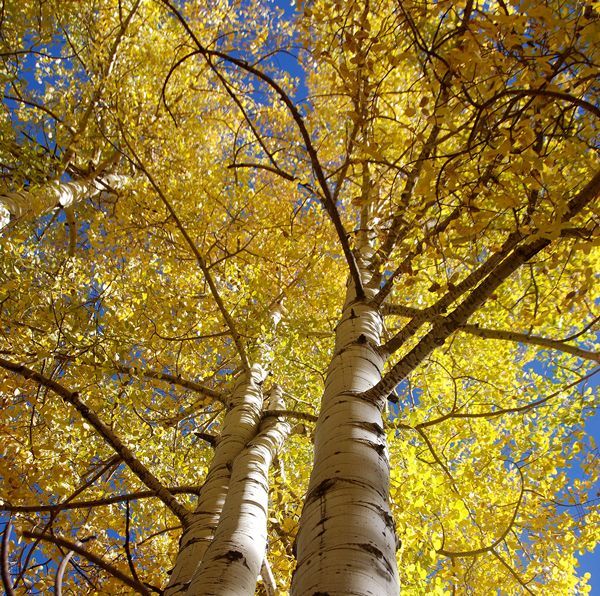
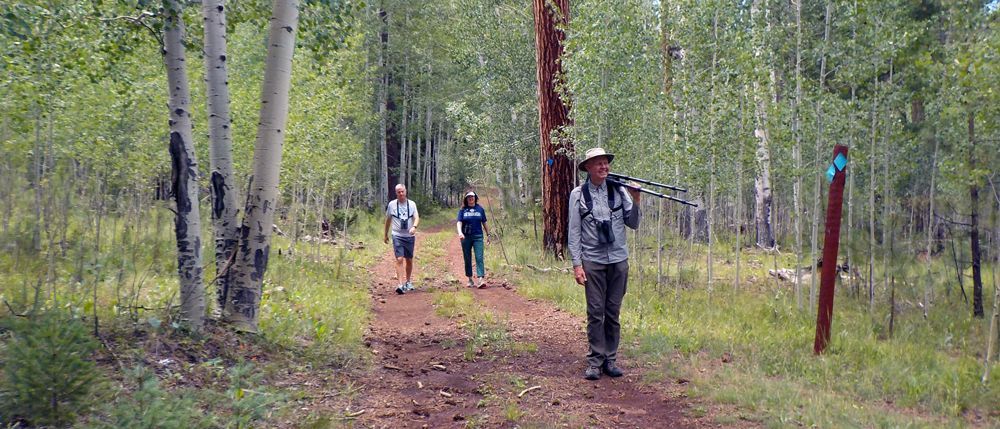
Revved up as we were with anticipation, we all hiked uphill at a rapid pace, with a variety of tall conifers and aspens on both sides of the trail; suitable habitat for our three targets. Because Eric not only has excellent hearing but also has a solid grasp of the various bird vocalizations, we could cover a lot of ground quickly so as to continue to gain elevation and therefore, presumably improve our odds of hearing and/or spotting our targets. Since I routinely go birding with many different people of many different skill levels, I am used to many birding styles. But I must say that I was impressed by how my new companions approached birding: quickly, quietly, and with an extreme focus on the entire world all around them.
As we continued our ascent, they would stop to enjoy watching one of the non-target species that also inhabit the slopes of Baldy: birds such as Golden-crowned Kinglets, Red-breasted Nuthatches, and Clark’s Nutcrackers. Periodically, I would observe my birding companions as they looked for birds and noticed that their heads were almost always slowly in motion: absorbing our realm for any sight or sound from the three species we sought. I also relished the fact that they were utterly comfortable birding without the use of their phones (many of today’s birders seem compelled to frequently consult their phones for identification aids and/or, of some concern to some of us, to use their phone’s “play-back” option — which allows people to use a recording of a bird’s vocalization to attract that species to the birder).
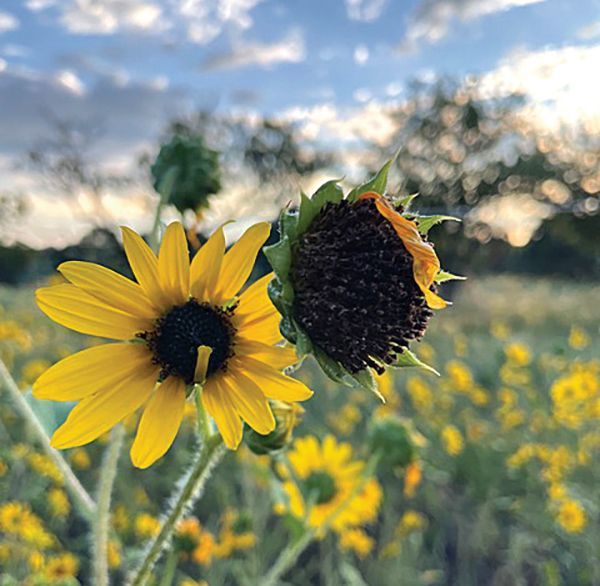
In the end, yesterday’s dawn to dusk efforts had been in vain for finding our target species, but, had been an overwhelming success in terms of seeing plenty of gorgeous birds, not to mention our having seen other wildlife and a stunning array of flowering plants, as well as lichens, mosses, and even quite a few mushrooms. And today, when I again met up with the crew to look for catbirds (a somewhat uncommon species in Arizona) in a mid-elevation riparian area, we failed to find the catbirds but enjoyed observing another 30+ species of birds. Additionally, because it was a partly cloudy morning, we were also witness to a brilliant, arcing rainbow and a separate, spectral prism; situated all by itself like some lone, stained-glass window into infinity.
After we completed our survey of the riparian area, we returned to higher elevations to resume our search for grouse, grosbeaks, and jays. We never found the grouse or grosbeaks, but eventually, while we were hiking along an overgrown trail, one of our crew caught a glimpse of something jay-like, and so we all worked our way through the dense forest until somebody stopped suddenly, stood stock-still, and pointed to a fluffy Canada Jay, perched motionless 20 feet up in a fir tree. Soon, we saw several more, and everybody feasted their eyes on this group of spunky birds more typically seen in the Far North.
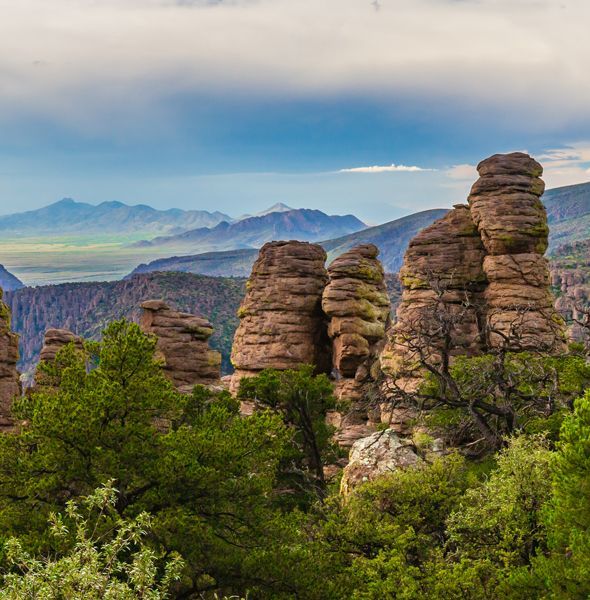
As things turned out, we ended our birding today by mid-afternoon, and so I could get back home and jot down the full list of species we had found both yesterday and today. One of the last critters I observed before leaving the 8000-10,000 foot country was a grizzled adult badger as he scuttled across Highway 260 near the Green’s Peak area. Badgers may not be rare, but in Arizona, I don’t see them nearly as often as I would like.
So now, with my reflections upon the past two days winding down, and with our only having observed one of our three target species, I nonetheless consider every moment of our explorations into the natural world to have been precious and memorable. Add to that, the fact that I met three new friends; which I consider to be the “cherry atop the sundae.”