Trading Post Southwest
On any given day, you might find Don Mayo jamming with his friends at his local shop in Pinetop. He is a former band member from years past and has a passion for music. Mayo has been in business for over 20 years and a part of the community for many more. His business, Trading Post Southwest, has served as Pinetop’s iconic location for Native American artwork and jewelry for years. In the world of Trading Posts and their legendary history, Mayo carries on the tradition and has the knowledge and savvy to choose and sell some of the best jewelry on the market.
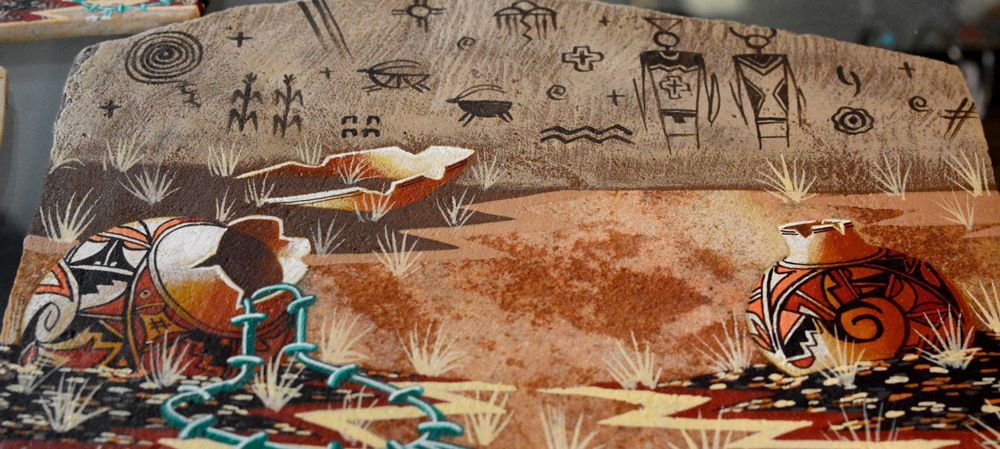
For those of you who haven’t ventured into Trading Post Southwest, you’re in for one of the most incredible cultural experiences in the White Mountains. Mayo’s huge inventory of authentic Native American art and jewelry includes wood carvings, metal artwork, paintings, pottery, baskets…and a vast amount of silver and turquoise (and other precious stones) jewelry — bracelets, necklaces, bolo ties, rings and brooches. Mayo has an eye for collectibles and offers free appraisals. On a good day, he may even be willing to negotiate. His list of noteworthy Native American artists includes Richard Gorman, Jacob Warner, and Wilfred Bahe, to name a few.
He has an impressive collection of Richard Gorman’s art. Gorman lives near Holbrook, Arizona, with his wife, Gloria. Although Richard is welcome in both the Navajo and Hopi tribes, he is considered Hopi, not Navajo. Richard’s mother, Clara Pahoema, is Hopi, and his father, Bobby Gorman, is Navajo. Both the Hopi and the Navajo consider children to be born into the mother’s tribe, clan, and family. People often mistakenly identify Richard with the well-known Navajo artist R.C. because of the Gorman last name. Gorman. There appears to be a distant relationship, even though when asked, Richard stated he is unaware of any. Richard’s great-uncle on his father’s side is Carl Gorman, the noted Navajo code talker from World War II. Likewise, R. C. Gorman’s father is also a famous code talker named Carl Gorman. We are unaware of more than one Carl Gorman who was a Navajo code talker! Richard was born April 20,1962 in Keams Canyon, Arizona, and raised on First Mesa, Polacca, Arizona. Richard had little more than a passing interest in art until his stint in the US military. In his early years, he was a bit wild and rebellious; however, during his four years in the Army, he spent a tour of duty in Germany where he saw the work of Bavarian wood carvers. This had a profound effect on him, and he envisioned his own future as a carver after his military duty. He states that his work is influenced by his culture, both Hopi and Navajo, and other artists such as painter/carver Neil David Sr.; painter Helen Hardin; jeweler Charles Loloma; and others. Richard is better known by many collectors for his paintings, as he is more prolific in that medium and relies on it for a more consistent source of income. He states that painting allows him greater freedom to experiment and create. It is very therapeutic and soothing for him. The Helen Hardin influence is evident in his abstract work, but it is not just an extrapolation of what she did. Richard is moving in his own direction to create his own unique style. Richard has shown his work at various shows around the country such as the Pueblo Grande Museum, Heard Museum, Eiteljorge Museum, Native American Film Festival in San Francisco, CA, Kansas Indian Market, White Mountain Native American Art Festival, and the Gallup Ceremonial. He won awards for both his paintings and Katsina carvings at several of these shows.
Jacob Warner’s wood carvings exhibit incredible detail and color. Each piece wraps pieces of Warner’s culture into beautiful art. Jacob N Warner was born in Albuquerque, New Mexico, and raised in Old Laguna Pueblo. Warner has experienced art throughout his life, as his Auntie and godmother, Regina Pino, a renowned pueblo potter, raised him. Pino saw Jacob’s potential and strongly encouraged his creative nature; while providing years of hands-on experience and knowledge that naturally comes with growing up in the village. Warner’s inspiration and drive to paint and carve come directly from his childhood memories, his family and friends, and his life experiences. “When I am carving, it is all these things I think about,” he says, “all this can go into one carving.” He will also tell you, “First and foremost, I am a Christian. Without my Lord Jesus Christ, this is just a piece of wood.”
When you experience one of Jacob’s works of art, whether carving, sculpture, or painting, you know you are in the presence of something very special, “very spiritual.” Warner will also share with you his philosophy: “Stories need a happy ending and should be shared.”
There are so many beautiful pieces of art and jewelry to be found at Trading Post Southwest. Stop in and see Don, and let him tell you more about these Native American treasures.