All about Termites...
By Carol Godwin, Cycle Mania
The monsoons have made their appearance and summer finally feels like the Arizona summer we expect each year; hot humid mornings with the air becoming more and more hazy until we can see the cumulus clouds building up their blindingly white cauliflower tops and blue grey bases, promising life-giving moisture. There is a noticeable change in temperature; a slight breeze begins to fall from the direction of the cloud bank, and we know that shortly there will be rainfall. If the clouds are greenish at the base, we can predict hail, and as the afternoon progresses, we watch the virga begin to descend from the clouds and then re-condense before hitting the ground. We are greedy for it; we post our rainfall totals on social media as if it’s a personal achievement and the daily conversation revolves around whether we will have rain today and if the trails are too wet to ride or just right “hero dirt” after the last storm. We look at the big picture and hope for enough rainfall to saturate the soil and run off into the dry tanks, but not enough to wash away our driveways and flower beds. Some of us are already looking towards winter and the “Super El Nino” that is supposed to be building up over the Pacific, prepping for a wet and snowy winter.
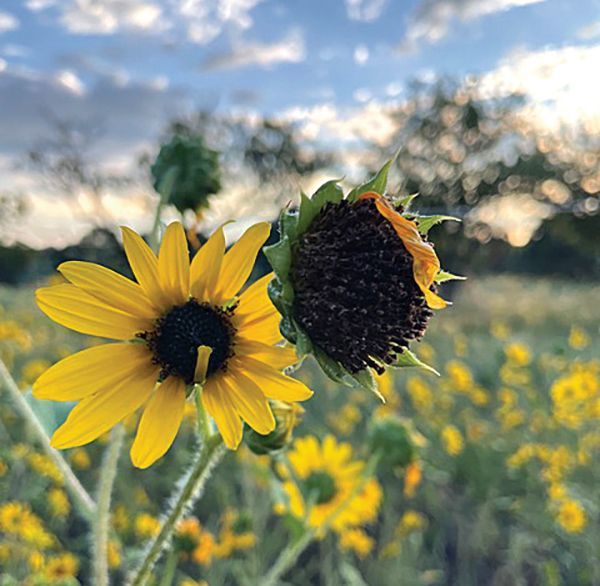
The brown, dead pines and pinyons around us are yesterday’s news, and now we are amazed at how fast the roadside vegetation is greening up and growing, sunflowers already blooming and young trees sprouting up in the bare areas between old trees. It’s a gorgeous time of year in Arizona and something we’ve sorely missed the last couple of years, but while we appreciate the big picture, something amazing and invisible to us is going on under our feet as we hike through the woods, move around in our yards or bike familiar trails. Something major in the ecosystem, becoming visible only a few days a year just after the cicadas complete their life cycles and just before the monsoons begin. Something completely dependent on the nearly undetectable meteorological changes that happen while building up to monsoons and something that can tell us that the monsoons have arrived with much more accuracy than a date on a calendar or a percentage prediction on a weather app.
If you climb up to the Lake Mountain Fire Lookout Tower during the summer when seasoned lookout Allen Allen is present, he is more than happy to show you the data he has collected over the years on monsoons. Allen has stacks of notebooks recording the wind direction, temperature, time of cloud build-up, direction, frequency, and locations of lightning strikes, and the amount of precipitation. He often stays in the lookout tower, perched on a stool with resistors on its peg-like feet, and watches the lightning storms roll over the forest. He has amazing pictures of lightning, stories of near misses, and…records of ants. Lots of records of ants. Why does a fire lookout care about ants? Because ants, and their insect nemesis, termites, predict the monsoon season with far more accuracy than any weather instruments, satellite data, or meteorological computer programs. Allen can tell you to the day when the first significant rains will begin based on the swarming and colony mound construction of our various minuscule subterranean neighbors, and some knowledge and awareness of the behavior of these insects will give you that ability too.
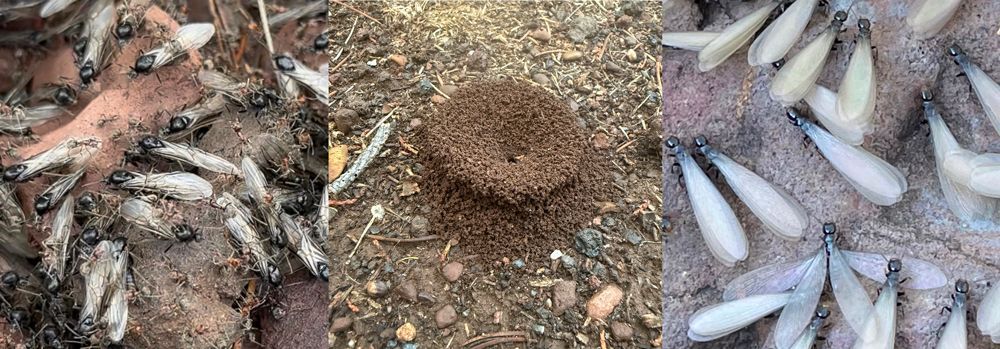
A couple of weeks ago, I was hiking on one of my favorite trails around the prominent knoll near my house; the morning was hot with the humidity high. Suddenly I realized that the ground appeared to be moving under my feet, alive with fluttering wings in what I knew from previous summers was a termite swarm. Great news! The termites know when the monsoons are arriving and always swarm just before the first big rains. Wahoo! I stopped to look at the section of trail that I had noticed and then saw another swarm site and another and another, with dozens of swarming sites over probably a 300 to 400 foot area! Kneeling down to get some pictures, I could initially see that there were hundreds of thousands of large-winged termites, with their bulbous heads and un-foiling wings crawling out of holes in the ground.
As I got closer, I could also see something that I had never noticed before in a swarm: there were probably 10 times the number of non-winged individuals attending to the winged ones. They were using their feet and mandibles to groom the freshly unfoiled wings of their winged counterparts and were creating a network of tiny highways connecting the various swarm holes, moving into, out of, and around the massive underground colony producing the swarm, all connected, all perfectly timed and all in frantic and coordinated chaos.
Suddenly, from some indiscernible cue, based, I’m sure, on air temperature, humidity and wind speed, they rose off the ground, their gossamer wings lifting them in a cloud of reverse summer snowflakes, fluttering and reflecting the sunlight like a million magical fairies of the wood. This makes life worth living for me, seeing the wonder in natural things; looking beyond the knobby heads, the crawling legs, the potential house-gnawing mandibles, and the innate biases we have against our insect brethren. We are all only one living thing in the tapestry of life that makes our planet and our home in the vastness of space, each species and member of each species unique and incredible. If we appreciate the whys of evolution that created each species, we can better understand ourselves and certainly make our human existence better for it.
Termites are a fascinating example of social engineering and have one of the most complex social systems in the natural world. For all their similarities to ants — social structure, underground colonies, and seasonal swarming — termites are actually only distantly related to ants in the Arthropod Phylum and are more closely related to cockroaches. Termites evolved about 150 million years ago from a more solitary creature, and through a need to share the symbiotic gut microbes they depend on to digest cellulose, they developed one of the most biologically complex social structures in the animal kingdom. The social structure of termites, similar in evolution to ants, a common phenomenon called convergent evolution, involves several classes of individuals. Think of a game of chess in the insect world, with a king and queen, defenders and protectors of the royals, and the main working class of pawns that can advance to another role if needed.
The main component members of the colony are sterile workers, the tiny helpers I saw during the swarm. The workers are responsible for nest construction, grooming the soldiers and royal couple, feeding and cleaning the larvae, soldiers and king/queen, and amazingly can transform into either soldiers or fertile royals if needed. The lifespan of a worker is one to two years unless they transition into royalty, which in itself is an amazing process. Note that the lifespan “clock” of these workers can “reset” is an interesting factor that is being researched and may help us understand how to extend human lifespans.
The fertile reproductive king and queen are paired for life and produce tens of thousands of fertile eggs a day. The queen, similar to the queens of ants and bees, develops an enormous abdomen to produce these eggs, making her easy to identify. Unlike ants, where the queen is fertilized once, a termite queen needs to be continuously fertilized by her king, and they remain sequestered together in the reproduction chamber for life. The termite queen is the longest-lived insect on earth and can live 30 to50 years, laying up to 30,000 eggs a day…do the math! The royals are fed special easily digestible food called “royal jelly,” do nothing but reproduce, have massively activated antioxidant enzymes which prevent cellular aging (another aspect scientists are studying for relation to human lifespan) and are heavily protected by soldiers, helping create their amazingly long lifespan. If either of the pair dies, the colony can promote a worker into the position through amazing chemical and morphological changes.
The soldiers have heavily armored heads and enlarged mandibles that protect the colony. The mandibles are asymmetric and can build up enough kinetic force that when deployed, can decapitate an ant with a flick. The mandibles of the soldiers are so massive that they cannot feed themselves and rely completely on the workers to feed them and supply gut microbes for digestion. When they are hungry, they tap a worker’s head with their antennae, and the worker will regurgitate pre-digested fluid into the soldier’s mouth. If a colony is disrupted and the soldiers are separated from the workers, they will quickly die from starvation. Some types of soldiers can also spray chemical irritants or sticky fluid to deter and trap invading enemies, largely their ant nemesis. Some varieties of termites have suicide bomber soldiers which literally explode themselves to protect the colony! After a battle or loss of a significant number of soldiers, the royals can trigger hormones which instruct workers to feed certain larvae a special hormone they secrete. These chosen larvae quickly develop the massive heads and mandibles of soldiers and begin their role as colony protectors. Young soldiers stay deep in the colony and guard the royal chamber. As they mature, they move to the internal colony pathway tunnels and patrol for foreign invaders by smelling every individual who passes through the tunnels. When soldiers are older and thus more expendable, they move to the upper edges of the colony and outer foraging trails, patrolling for outside invaders, neighboring ant patrols. One method of colony protection involves these soldiers cramming their armored heads into the hole created by an invader, effectively building a living wall while workers behind them fill the breach with mud made from saliva, feces, and dirt. Another amazing fact about termites is that where there is an attack, they can use their heads hammering on colony walls to send a warning signal across the entire colony system virtually instantaneously, bringing all the soldiers to defend the breached area and triggering internal chamber soldiers to refortify the royal chamber. How amazing is that?!
The last category of members in the social system is the alates, which are the winged ones we see swarming in summer just before the rains. The alates are created once a year by a process similar to that of producing new soldiers, with hormones secreted by the queen telling workers to feed a percentage of the larvae different food so that they are prepped to swarm when the conditions are correct. These alates are the future royalty and will pair up when they find an appropriate place for their new colony. The wings on an alate have detachment points which allow the wings to snap off after mating with light pressure, and the new couple do a “detachment dance” where they run backwards against objects and vibrate to detach the wings, prepping for their final entrance underground never to re-surface.
After finding an appropriate spot, the pair will dig a mating chamber and begin producing up to 30,000 eggs a day for the next few decades, relying completely on their offspring to feed and protect them in their underground castle. How, you may wonder, do the king and queen begin the colony without workers? Well… the royals feed the new offspring with nutrient-rich saliva from their mouths and microbial-rich excretions from their anuses. To feed themselves, the royals digest their now unneeded flight muscles and, if needed, will eat some of their new eggs. As soon as there are enough workers to take over the feeding of the subsequent offspring, the royals focus solely on reproduction for the rest of their lives and are fed and groomed by their millions of identical offspring. Only about one percent of the swarming alates will survive to colonize a new nest, but with millions swarming from colonies in an area, this is plenty to keep the local colonies growing and thriving. The mass synchronized swarming of multiple colonies is another example of the predator saturation strategy employed by cicadas, where there are literally too many of them to eat, so the rest can survive.
Most of the termites in the Southwest are subterranean termites, living in vast underground networks 4 to 18 inches below the ground, as I found on the trail. These native termites live in colonies of up to a million individuals. They depend on the humidity levels provided by the organic material found in the soil and concentrate where there is enough organic matter to protect them. They cannot travel above ground for long, and the swarming process is based on predictable ambient humidity levels because of this. If they need to move across non-porous materials like clay, concrete, or rock, they can build mud tubes out of saliva, fecal matter, and dirt to protect them from the drying air and from predators like ants, lizards, and birds. As they devour wood, they often pack this “mud” into the boreholes they have created to keep the wood from drying out and to protect themselves as they travel inside the rotting tree (or your house). As a good example of how fast termites can process wood, one colony can consume about two feet of a standard two-foot x four-foot board
in a year.
Like all cellulose-consuming animals, from bark beetles to beavers and caterpillars to cows, all termites depend on the presence of microbes in their guts to process the cellulose they eat. (As an interesting side note, humans also contain these cellulose-processing microbes in their guts, and eating a high-fiber, more vegetarian diet will stimulate their growth and reproduction, enabling vegetarians to be more effective at processing the cellulose they eat. We can also take supplements of the cellulose-digesting enzyme found in these microbes, cellulase, to help more efficiently digest plant material, but no, you cannot survive by eating a tree!). In early evolution, flagellated protists, containing cellulose digesting microbes, lived symbiotically in the guts of the termites and relied on the termites to supply cellulose, while they themselves relied on bacterial microbes to process that cellulose and pass on the digested material to the termite host.
Over the millennia, termites could bypass the protist middleman in their digestive systems and become fully reliant on the microbes previously present in the protists. This enabled them to digest cellulose more directly and become more diversified and efficient organisms. These microbes are passed from workers to the next generation by a process of anal to mouth feeding, where the pre-processed food, along with the symbiotic microbes, is fed to the developing young. Workers are the vital parts of the decomposer level in the ecosystem and the ones who also do all the damage to homes.
One way we protect our homes from termites is to use wood treatments such as borate, that block the digestive enzyme cellulase and cause the workers, and thus the rest of the colony, to starve or move on to a more appropriate meal like that dead log in the yard. Other more short-term methods of discouraging termite workers from utilizing your home for a diner are to use oils like orange, clove and garlic oils which break down the protective exoskeleton of the workers, or use scents like pine, cinnamon or lemon grass to disrupt feeding trials and repel foraging workers. Mass-spectrum insecticides should not be used as they kill beneficial insects and will move up the food chain to kill lizards, small birds, and eventually owls, hawks, and other predators.
Please don’t…
From lichens and termites, and sunflowers to wolves, each being irreplaceable in its own way in the ecosystem, it’s a constant cycle of building up and breaking down the carbon chains that make up every living thing. It’s self-defeating folly for humans to even imagine for a moment that they have a greater combined intelligence than billions of evolution. No, we don’t like our things being eaten up by termites, but widespread use of insecticides to kill insects including termites, causes there to be a less breakdown of organic matter and slower soil production along with a buildup of fuel materials, as trees die or naturally shed old lower branches not receiving enough sunlight to be helpful any more. The lack of recycled soil nutrients and water-absorbing decayed organic matter in the soil leads to more runoff, less water absorption, and drying trees. The un-decayed fuel buildup and water-stressed trees logically lead to higher fire danger, where nature recycles its carbon in an accelerated and spectacular way, not so beneficial to us humans.
The next few years should be banner years for the termites, ants, fungus, and other decomposers, as they process the literal windfalls of the massive pinion and pine die-offs going on now. Pinions rot and fall quickly and will litter the forest floor, ready for the next step of their lifecycles via decomposers to become fertile soil for the next generation of trees to follow. Bark beetles to termites: all a part of the natural progression of life in the forest.
Every piece of our ecosystem is valuable, and finding the edges of each piece to see how it fits is what keeps me going out each day on the same trails, with still so much to learn every time. Never stop learning, never stop feeling the humility of not knowing, and never stop fighting for the protection of our vulnerable natural resources. So yes, protect your home from termite invasions by having concrete foundations and keeping old wood away from the walls, but when you see them swarming, appreciate the transient beauty and don’t just automatically pour poison down a hole or dig up swarming spots. They will be gone in an hour or two, and the ground will return to its original still and quiet surface as if they had never been there at all. Happy Monsoons everyone. Enjoy the thunder and lightning and the magical green-up that is now in full swing.