The plight of the cicada
Article and photos by Carol Godwin, Cycle Mania
It’s early dawn, and besides the slight rustling of oak leaves, it is silent…until there is a soft, almost metallic clicking noise from one of the nearby junipers. Click----click---click--click-click, gradually increasing in volume and frequency and now joined by another set of clicks nearby and then another. Soon the surrounding forest is a cacophony of clicks, each competing with the others, each nearly indistinguishable from another to human ears, but each with one intent, one message: Here I am! Come breed with me! I’m loud, proud and healthy with a great set of genes to share! As the morning sun rises, the frequency of the clicks increases until it becomes a sustained buzz, rising and falling in volume in response to air temperature and movement near the originating branch. What is creating this summer racket, and why can’t I seem to pinpoint where the sound is coming from? This classic summer symphony is the mating call of the cicada, an insect with several interesting adaptations and numerous fables surrounding it.
Pay attention as you bike, walk, or hike through a forest full of singing cicadas, and you’ll notice that there is a cone of silence that surrounds and moves with you as you travel; the buzzing is always ahead or behind you. This hyper-awareness of their surroundings is one of the many adaptations that cicadas use to reproduce successfully in a world full of predators relying on being able to eat them during their short adult stage of life. Challenge yourself to find a buzzing cicada, and you will quickly see why it is hard for predators to pinpoint one individual within a buzzing forest of thousands of tasty morsels. You may be certain that the buzzing is coming from one particular branch, but when you look, there is nothing but silence. They seem to be simultaneously everywhere and nowhere.
Cicadas have five eyes: two large eyes on the sides of their heads adapted for motion and shadow detection, and three triangulated eyes between these outer eyes which detect light intensity and help the cicada maintain a stable flight pattern. As well as having excellent detail and motion detection vision, cicadas can see in full color and detect polarized light. Cicadas have adapted to predation by being able to react to nearby movement through ceasing buzzing and then quickly moving to the back side of the branch. Finding a cicada in the midst of all this racket feels nearly impossible, and remember too, for all the surrounding sound, this represents only 50 percent of the population doing their best to remain both unnoticed by predators and noticed by females all at once! Only male cicadas can buzz, leaving the females relatively protected from predators and giving them a better chance to lay their 400 to 600 eggs after breeding.
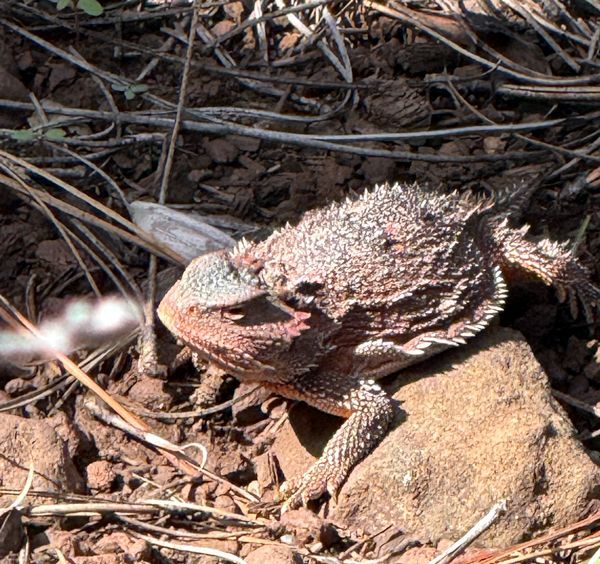
Cicadas are an important part of the ecosystem food web and benefit animals from birds to lizards, foxes to coyotes, turkeys, and even squirrels and raccoons. The strategy used by cicadas is to overwhelm predators with their vast numbers so that at least a few survive to reproduce, a strategy known as “Predator Satiation.” Cicadas cannot bite with their straw-like mouthparts, but they are a challenge to hold on to because their weirdly vibrating abdomens and sharp pincher-like claws make the predator, or you, feel as if they were being electrically shocked. One of the most ghoulish and interesting predators of the cicada is the cicada wasp, which, similar to the strategy employed by the tarantula wasp, paralyzes the cicada, drags it into its burrow, lays eggs inside the cicada, and, as the wasp larvae hatch and grow, they feed upon the still living, but paralyzed, cicada.
Arizona boasts over 45 species of cicadas ranging in size from about the size of your pinky to the size of your thumb. The most common cicada in the White Mountains is the Apache Cicada, a medium-sized cicada that has reddish eyes, a black and tan body, and a tan collar behind the head. Unlike the periodical Eastern cicadas, our western cicadas do not have multi-year cycles where they appear in mass every seven, 13, or 17 years.
Our western cicadas spend one to three years feeding underground and then only live two to three weeks as reproductive adults. After mating, the male quickly dies, and the female lays eggs 5 to 10 days later and dies shortly after laying eggs. The eggs hatch about 40 days after being laid, normally coinciding with the onset of the summer monsoons. The new ant-sized hatchlings drop to the ground with the rain and can burrow deep underground near the tree roots, feeding on tree sap for one to three years until they are triggered to pupate and emerge ready to become reproductive adults, starting the cycle over again.
Cicadas are temperature-dependent insects that have evolved to thrive in varied environmental conditions worldwide, with close to 3,500 species discovered to date, existing on every continent except Antarctica. The first cicada ancestors evolved about 200 million years ago and were not flight-dependent. As the first birds appeared about 150 million years ago, cicadas grew stronger bodies and developed wings to evade these new predators. Modern “singing” cicadas appear in the fossil record about 60 million years ago.
How do we know that these ancient cicadas were precursors to our modern singing cicadas? The main distinguishing feature of a male cicada is that it has a nearly hollow abdomen, with internal organs pressed outer edges, creating a drum which magnifies the buzz created by the vibrating tymbals. This unique hollow abdomen is easy to see in fossils beginning about 60 million years ago. I think it is interesting to think that a prehistoric summer day would have had the same background symphony as we hear today.
Daytime temperatures control the change from clicking to buzzing and also impact the volume of buzzing because the click-producing membranes, the tymbals, only become flexible enough to make noise above about 72 degrees and as the cicada buzzes, it creates internal muscle heat, which increases the volume of the sound in a feed-back loop. Soil temperatures trigger cicadas to emerge, with most waiting until the temperatures reach about 64 degrees. If you pay attention to the ground under the buzzing trees, you can see dozens of circular one-quarter-inch holes from which the young cicadas emerged. These holes benefit the trees they are under by creating open, direct passages from the surface to the roots, providing soil aeration and permeability just in time for monsoon rains. Waiting to emerge dependent on soil temperatures helps coordinate the mass exodus needed for breeding and predator satiation and also ensures that the trees they will feed on have come out of winter dormancy and have newly flowing sap and soft new bark for females to lay their eggs under.
Besides the physical reasons for the correlation between heat and sound for a cicada, there are predator avoidance evolutionary reasons as well. Most desert creatures prefer to hide out and remain relatively inactive during the hottest parts of a summer day. This opens up a niche for the cicada to be active in relative safety. Cicadas that are more active during the hours when there are fewer predators were more successful in reproduction and therefore passed this trait along to their offspring. They are one of the few insects that “sweat,” and they can lose up to 30 percent of their body weight in water loss per hour, resulting in the same evaporative cooling effect provided by sweating. Cicadas can withstand desiccation levels that would be lethal to most other insects and require nothing but sap for both nutrition and hydration. They survive by sucking fluids out of plant roots as larvae and nymphs, and then from plant stems as adults.
Most of the cicada damage you see on tree branches is the result of the females cutting slits to lay eggs, 10 to 15 at a time in short rows, normally 40 to 50 egg slits per female, totaling 400 to 600 eggs! The female cuts these slits in tree bark with a specialized saw-toothed organ called an ovipositor (ovi=egg and posit=depositing), located at the rear of the abdomen. This ovipositor can both saw the slits and lay the eggs in the slits as it saws — another amazing tool created by evolution! Females choose young twigs between .25 and .5 inches in diameter and cut the slits parallel to the twig. Often, this causes the end of the twig to die and the leaves to turn brown, a phenomenon called “flagging”. Unlike many insects which specialize in using a specific plant species, cicadas have no preference for one tree species over another and can use anything from a dry juniper to your well-watered apple tree.
Our primitive human ancestors and native peoples across the world and in the Americas have relied on cicadas as a dependable and nutritious food source, either roasted or fried, and many traditional native myths have the cicada as a character representing resurrection, healing, and survivorship. The Hopi people tell a story where two cicadas play a flute to heal a hero shot by arrows, and some say that the classic hunchbacked Hopi flute player is a representation of a cicada. The Navajo say that cicadas were the only beings able to dig up through the earth to lead the people from the 4th to the 5th worlds and are able to heal wounds with their buzzing.
The Chinese believed cicadas represented immortality and created jade talismans which were placed in a corpse’s mouth to encourage the spirit to rise out of the body and continue on in a different plane. Since cicadas emerge in June and monsoon rains often begin in July, people use them as harbingers of summer and predictors of upcoming monsoon rains. The cicadas are here, so let’s hope the monsoons will follow. Rain…rain…dreaming of rain!
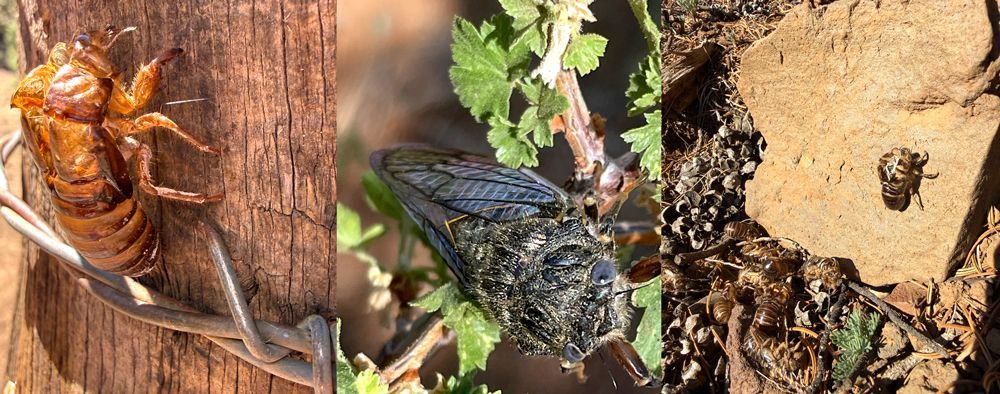
To me, the sound of the cicadas buzzing in the trees is a sound inextricably linked with summer vacation, warm lazy days and taking the time to do nothing but try to find the buzzing insect hidden away on a branch, so close but so hard to see. I can find amazement in the brittle shells left clinging to trees and try to imagine how an entire insect, with wings and eyes and legs managed to develop inside this perfect skin and emerge, soft and vulnerable, and then only hours later be encased in a hard exoskeleton with fully expanded wings, ready to take on the world, loudly and without reservation. A summer day without cicadas would be empty and terrifyingly quiet. This is nature’s gift to us: the ability for us to get out of our own consciousness and be able to understand the intricate workings of other creatures. It’s truly inspiring to explore as much of what is out there as possible within our own small human scopes of understanding. Keep on buzzing!