A large charismatic raptor...
Article By Rob Bettaso
Photos By Doug And Rhonda Forsha
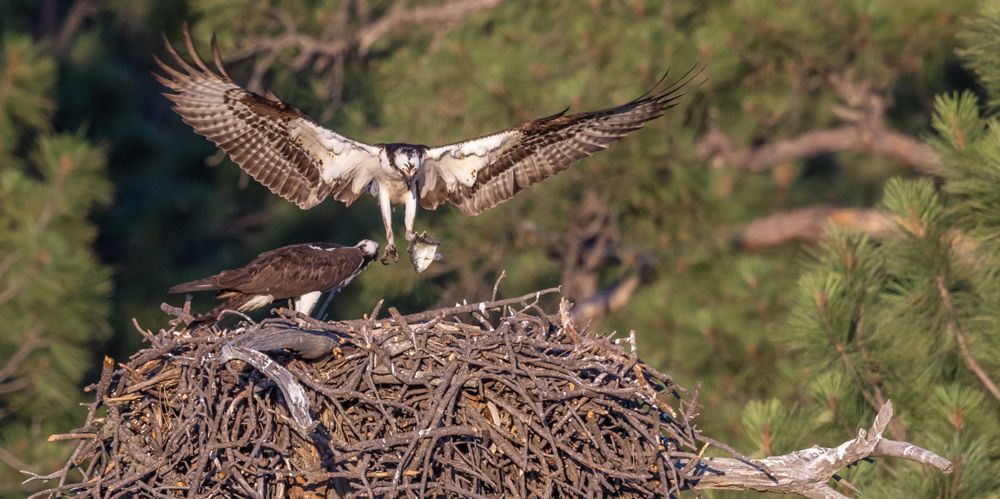
This and last year, during the months of spring and summer, I have periodically joined my friends Doug and Rhonda Forsha as they have photographed a pair of Ospreys that nest along a nearby creek. Our local Osprey pair’s story could essentially fulfill the basic plot requirements of any number of published plays, operas, novels, or films: namely, two individuals meet; commence courting; bring new life into the world; watch their young grow and become independent; and mark both successes and tribulations as they live out their lives – half of the year in their warm-season home of the White Mountains of Arizona, and the other half in their wintering grounds somewhere to the south (where natural waters stay liquid, year-round).
During these past two years, I have not only become closer friends with Doug and Rhonda, but I have also developed something of a bond with the Osprey pair. Off-hand, I would guess that most people who have noticed Ospreys anywhere within the bird’s nearly cosmopolitan range, have taken an almost instant liking to this large, charismatic raptor. And it is certainly easy to see why: Ospreys are handsome birds, bigger than hawks but smaller than eagles, that feed exclusively on aquatic prey (mostly fish) which they spot by hovering high overhead, so as to get a solid bead on their target, and then plunge feet-first into the water to seize a carp, trout, or whatever species of fish meets the size and weight requirements of these powerful predators.
Of course it wasn’t always the case that humans respected Ospreys, or really, any of the birds of prey. Perhaps from about the time man invented the long-range firearm, raptors have faced a formidable enemy. Early on, it may be that we slaughtered hawks, eagles, and owls because they threatened our smaller breeds of livestock and our preferred game species; but, eventually, humans decided they didn’t even need a reason to blast a big bird, other than people apparently simply enjoyed the sight of a large, plummeting bird that they had struck with a round from their .22 rifle. At some point however, various laws were passed to protect raptors from such mayhem; but unfortunately, other horrors awaited them, such as habitat destruction and pollution (including pesticides, especially the infamous DDT).
When I was growing up in Michigan in the 1960’s, not far from Lake Erie, environmentalists were beginning to see some of the early fruits of their labor. The Great Lakes, and many other smaller waters, were finally being cleaned up such that the diverse fish populations were beginning to rebound. A little later, the banning of DDT in parts of the U.S. eventually enabled raptor eggs to fully develop such that new generations of birds, including Ospreys, were beginning to repopulate portions of their historic range. As your average kid, who had a love for all animals, I found this very inspiring and before I had even finished Elementary School, I knew that when I grew up, I would be a biologist.
In the mid-1970’s, when I enrolled at the University of Montana, I began a career as a Wildlife Biologist that would last my life-time. While at the U of M, it didn’t take me long to discover the Ravalli National Wildlife Refuge (later re-named for a Montana Senator, Lee Metcalf) not far from Missoula. At the Refuge, I was thrilled to see that Ospreys were fairly abundant and that the Refuge was large enough to harbor a few nesting pairs. Not surprisingly, for one of my early entry-level Wildlife Bio classes, when our instructor assigned us the task of choosing a local critter on which to write a “species account,” I chose the Osprey and was able to augment my “lit review” with first-hand observations of the Ravalli nesting pairs.
Fast-forward to the present, and I am happy to report that the warm-season Ospreys that inhabit the White Mountains area of Arizona are even more abundant than those long-ago birds at the Ravalli Refuge and the adjacent environs of western Montana. Moreover, thanks to Rhonda and Doug, I am once again taking the time to get to know some nesting Ospreys and monitor their active and interesting lives. As it turns out, over the period of time that I have been accompanying the Forshas as they photograph Ospreys, I have come to learn that in addition to the six nests that I had previously known about in our area, there are at least another five, of which I had been totally unaware. For several of these nesting pairs, their large stick nests are situated atop old pine snags along the banks of small streams, which are generally too shallow to allow the Ospreys to fish in their accustomed plunging fashion. However, all of these nests are reasonably near large ponds and small lakes, so it appears that the creek-nesting Ospreys are willing to trade nest-side fishing, for a bit of seclusion in which to raise their young.
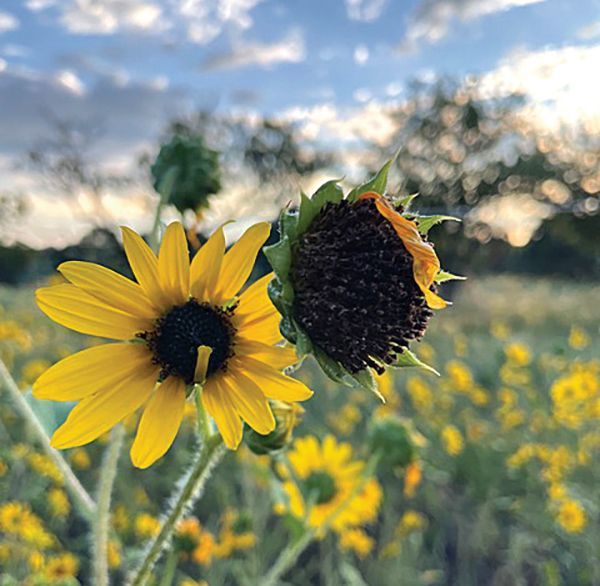
On some of our photo-outings, the Forshas are entirely focused on waiting for one or more of the Ospreys to strike the perfect pose for a memorable photo; but, on other trips, they spend only part of their time watching/photographing Ospreys, and the rest of their time hiking, exploring, and taking time to photograph other things - including landscapes, plants, and various birds and animals. For example, on one of this year’s spring visits to the Osprey’s nesting area, Rhonda set up a photographer’s “blind” near a pond so that she could train her camera on mud-gathering Barn Swallows (who presumably used the mud for nest construction) and Common Yellowthroats (a loudly vocal species of warbler), while Doug and I roamed randomly in the juniper/grassland countryside.
For a period of time, we watched a group of prairie dogs as they became more and more active with the rising of the sun. One particularly chubby dog seemed to be the designated sentinel for the colony; since he sat bolt upright on his haunches and stock-still near his burrow’s entrance. We watched him from afar as he vigilantly monitored both land and sky for potential threats; and while Ospreys generally don’t eat rodents, I’m fairly sure that prairie dogs don’t know that and instead assume that any raptor silhouette is tantamount to a flashing red danger-signal. But on that particular day, at least for the time we observed the dog-town, no predators revealed themselves. While the other dogs busied themselves with feeding and grooming, the lone sentinel eventually began to slouch a bit, and then seemed to slip into a semi-standing slumber. I couldn’t help but chuckle a bit, because the sentinel reminded me of a serene and paunchy Buddha, contemplating the mysteries of the universe (or at least his own scrubby, grassy portion of it).
Doug and I continued our wanderings; letting Rhonda continue to do all of the hard work of silently sitting in a cramped blind continuing her quest for the ever-elusive, “one perfect photo.” Having viewed many a wonderful photograph that Rhonda and Doug have taken during these very active years since their retirement, I can attest to the innate artistic sensibilities both of them possess – something they no doubt also applied to their architectural wood-working business based out of Phoenix. I suppose that when it comes to many of the visual arts, the compositional planning that an artist must consider includes such vital facets as lighting (including shadow and darkness); appropriate fore- and background elements; contrasting and complimentary colors and textures; and, that “just-right” expression, posture, or attitude of the central photographic subject.
When it comes to Ospreys, well, even such a basic behavior as procuring food, is a demonstration of “poetry in motion.” Although many of us have witnessed the sight of Ospreys fishing, one particular memory I have is perhaps worth relating: It was a fine, calm day and I had been hiking and bird-watching in the Woodland Lake Park area. When I came off the trail system and was about to head home I decided I would take just one quick lap around the, at that time, brimming full reservoir. As I set off, I stopped to identify some of the ducks on the water and at one point, while I stood near a guy who was fishing, he grumbled to me that: “The fishing in this lake sucks!” I merely offered a non-committal “Mmmm” and was about to walk off, when suddenly, I noticed the shadow of a large bird flying overhead. I looked up and sure enough, it was an Osprey, wheeling over the water looking for fish. Soon the big raptor located what he was seeking, and, while he hovered 50 or so feet above the water’s surface, his powerful wings still deeply beating, both the human fisher and I watched the avian fisher intently. At a crucial moment, the Osprey broke from his hover and dove down to the water like a plunging arrow (or maybe eight arrows, since Ospreys are equipped with razor-sharp talons on each of their eight toes). Then, there was the loud and dramatic splash! When the wet, but still regal predator emerged, he struggled slightly to free himself from the water, began his rise upward into the limitless air, shook violently to fling countless drops of glistening water from his feathers, and headed toward the deeper forests to eat his prize – a large and robust trout.
A bit later, when I returned to where I started after my lap around the lake, I considered saying to the still-scowling (and empty creeled) angler that I had seen two more trout caught by other Ospreys, one carp seized by a Bald Eagle, a wriggling minnow apprehended by a Belted Kingfisher, and a few bullhead-cats snarfted down by piscivorous herons. My reason for not telling him about such impressive fishing success was primarily due to the fact that I had actually seen those events over a several week timeframe, so I decided it was best not to mention it at all. Regardless, I did matter-of-factly let him know that the bird-watching was spectacular on that beautiful summer morn and then wished him “good luck” in his fishing.