A day to celebrate the diversity of life!
Article and photos
by Carol Godwin, Cycle Mania
What an absolutely glorious little rainfall we are getting today as I write this! I am so grateful for this respite from the dry…dry…dry we have had lately. It’s literally a breath of fresh air, and I can feel the plants outside breathing a sigh of relief, probably short-lived, of their own. Leaves are greener with the dust rinsed off of them, and photosynthesis will begin in earnest as soon as the sun peeks back out from behind the clouds.
The plan today, on this first day of astronomical summer, June 21, was to go out to move rocks and do trail maintenance on Land of Pioneers, but that plan has changed. Even a little rainfall out here turns the top layer of soil into a magically sticky substance (no, not mud) that adheres to tire lugs in rapid exponentially increasing depths, until wheels refuse to turn and drivetrains become one giant ball of abrasive adobe that takes an inordinate amount of time to get off using stout sticks and whatever rocks are nearby.
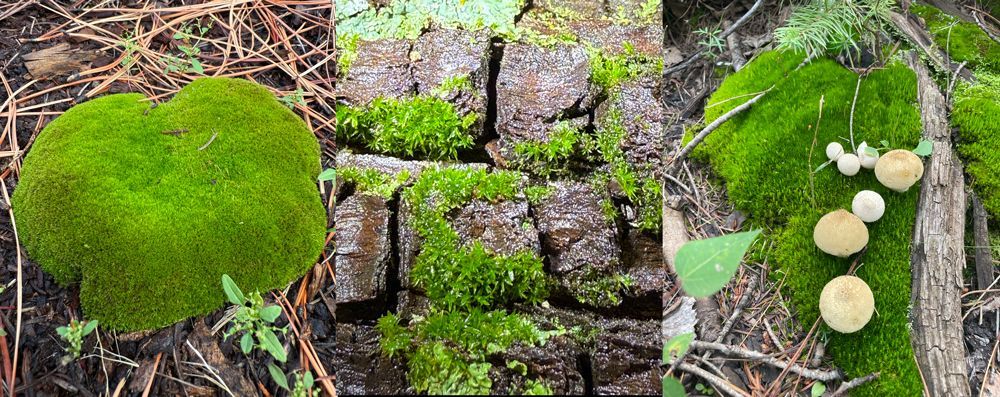
How, you wonder, is the ground under that 1/16” of moist soil still dusty dry, but you are incapable of movement on your bike? No, thank you. Looks like it will be a dog walk and moss hunt for me today. I can handle the ridiculous creation of mud-based high-heeled hiking boots on the short trip to the Timber Knoll cinder cone, and once there, the cinders are always safely dry-ish and the trails there are easy to walk on. Plus…even with a tiny sprinkle of rain like we just had, the normally hidden moss will now be explosively emerald green, photosynthesizing as if its life depends on it, as it actually does.
In the lichen article, No Rock Unturned, I explored how lichen is a mutualistic symbiotic relationship between the plant algae and a fungus, with the fungus providing protection for the normally aquatic algae and the algae providing glucose via photosynthesis for the non-photosynthetic lichen. This relationship was developed independently in multiple locations across the globe over millions of years and remains virtually unchanged today.
Lichens are easy to spot on rocks and tree bark, but after it rains, something magical changes within lichen communities. Suddenly the lichen appears greener, and under a magnifying glass, glossy emerald leaflets appear, creating a tiny jungle ecosystem where before there appeared to be only dry, flaky lichen. What are these leaflets?
I originally thought that the green appearing within the wet lichen was the algae showing itself and getting busy with its job of photosynthetic glucose production, but I was wrong. Algae doesn’t have leaves, and unprotected algae would quickly dry out and die. The algae in the lichen-algae complex is firmly and irrevocably bound underneath and within the semi-transparent fungal protective cell walls and gets its light through them. These fungal cell walls are more translucent after a rain, and lichen greens up because of this, but this is not where the green leaflets come from.
So, what is it? Is this a different type of symbiosis? Yes, and no. The green leaflets are an organism belonging to the non-vascular group bryophyte, and are commonly called moss. Moss often finds itself at home between lichen colonies and benefits from the protection of the fungal cell walls, as does the algae. Unlike the algae, the moss is an independent organism, not contained within the fungus, and the only possible benefit the fungus gets from the moss is the added water absorption properties of the moss. This relationship between lichen and moss would be considered communalistic symbiosis as only one organism actually benefits from the other.
Moss fascinates me because it’s always there, always ready for action at the slightest opportunity, and there’s something magical about how fast it can go from brown, dry, and inert to shimmering green and productive. There may be snow on the ground, but as soon as temperatures turn that snow into water, there it is…green patches poking out from the snowy ground around it. Moss can actually be frozen for thousands of years and easily recover once thawed out; a sample of moss frozen under Arctic ice for 1,600 years was easily revived! Like lichen, moss was placed outside the ISS in the frozen vacuum of space for months and revived itself after being brought back to Earth. It may be the driest spring ever, but come a few drops of rain, there it is, vibrantly green across the ground, climbing up the base of trees, and on rocks you would never have noticed before.
Dried moss withstands temperature extremes from -450 degrees Fahrenheit to over 212 degrees Fahrenheit! In order to survive these temperature extremes, moss contains a kind of natural antifreeze that, when eaten by reindeer, helps them keep the blood in their hooves liquid in extreme temperatures. Photosynthesizing moss removes and stores more carbon that all the tropical rainforests combined and releases equivalent amounts of oxygen into our atmosphere.
Moss evolved from algae nearly 500 million years ago and was the first plant to colonize land, with vascular land plants evolving 50 million years later. Moss was also one of the primary oxygen producers in the early history of the Earth and created the atmospheric oxygen levels that allowed vascular plants and other multicellular life to develop as we know it today. In other words, moss is part of the reason you can read this article, take a walk in the rain, build your home from a towering pine, or even pet your dog!
If you know where there was historically moss, you can find the dry brown pucks of moss colonies and sprinkle a little water on one of them. First, the blob will immediately expand like a sponge, and then in less than five minutes you will have a soft green cushion of photosynthesizing moss in your hand. Moss can absorb up to 30-times its weight in water. Truly nature’s magic! The absorbative and antimicrobial properties of moss have been used by humans since humans first evolved. Historical records show that ancient cultures used moss for diapers and menstrual pads, and that people used it during wars across the ages for battlefield bandages and blood-absorbing wound packing. During WWI, there were moss drives encouraging people to collect, dry, and package moss for bandaging material, and these naturally antiseptic wound-packing bandages saved hundreds of thousands of lives and limbs. Having this knowledge proves very useful in case of injury during outdoor activities, as you can find moss almost everywhere in the White Mountains if you know where to look.
Besides all the outstanding properties previously described, moss has an incredible lifecycle that makes it amazingly efficient at reproducing itself and may provide hints at the origin of the sexual reproduction of multicellular living things which developed later, including us! Let’s take a closer look at the biology of this amazing organism. Moss has alternating generational reproductive modes: both sexual and asexual. The asexual mode allows moss to reproduce identical copies of parents quickly and efficiently. This involves the “budding” of fragments of moss, which then can grow new individuals wherever that fragment lands. I have observed also, that some of the moss pucks that are not firmly attached, will curl up at the edges so that when there is overland water flow during a storm, they will travel downhill like little floating boats and will establish new colonies wherever they run against a damming stick or log on the hillside. If a moss puck is carried downhill by water, it can leave fragments as it travels, or dried moss can have fragments blown by the wind. Once a new organism is established, it can begin the next phase of reproduction, which is sexual.
There is something almost disturbing going on across the glossy surfaces of wet moss, and it will make you think twice about that moss patch you find after a nice rainfall like we are having today. The moss out there is having a moss party while it photosynthesizes. Sexual reproduction allows for genetic variability and enables neighboring colonies to share genes, keeping the population strong and resilient. Sexual reproduction begins within gametophytes, the main green structures you observe in a moss colony. Gametophytes are either male or female and produce stalks containing either a single egg or multiple sperm with tiny tails. When there is water present, the sperm use their motile tails to swim across the moist surface of the moss leaflets and reach the egg, fertilizing it. (Hmm…) Interestingly, most flowering plants developed other, more passive methods for sperm distribution involving the growth of pollen tubules, while most animals retained the water-dependent motile mechanism begun in primitive algae. The fertilized egg becomes an embryo and is nurtured inside a capsule atop a stalk called the sporophyte. The “embryo” does not develop into a new moss plant but creates multiple identical spores via cell division from the initial fertilization event. When the capsule dries out, the top opens, and spores are dispersed via wind, each spore capable of growing into its own organism. Some mosses don’t just rely on the drying capsule to open, but build up air pressure inside the capsule until it explodes with an audible pop.
The more I learn about our natural world, the more I want to know. It may feel boring to hike the same trail over and over and it can be boring if you only think about the trail and finishing the hike or ride, but if you allow yourself to go back in time, to learn about the lives of the organisms you see along the trail, to appreciate the subtle changes you see from season to season, you can find yourself entertained and learning every time you go out. Wonder why, wonder how, wonder what, and learn something new as you go along. Appreciate lichen, moss, wildlife tracks, bird songs, the timing of hummingbird appearance and wildflower blooms, or the appearance of cicadas related to the coming monsoons and the hatching of hungry chicks. Recently I’ve been watching a mother bird who nests annually on our porch support, bring cicada after cicada to her hungry brood, each cicada nearly the size of the hatchlings’ heads! How do they swallow and digest each buzzing, crunchy snack!? All of these things keep me going out for more, and I hope it does for you too.