Wild Horses...they are American
Anne Groebner
Wild horses. “They are freedom. They are independence. They are the ragtag misfits defying incredible odds. They are the lowborn outsiders whose nobility springs from the adversity of living a simple life. In short, they are American. Or at least they are what we tell ourselves we are, and what we aspire to be.” This is a quote from the book Wild Horse Country: The History, Myth and Future of the Mustang, America’s Horse by David Philipps. I recently read it cover to cover, as well as other publications, so I could understand the release of the Heber Wild Horse Territory Management Plan, a plan that will reduce our local herds from an estimated 500 horses or more (from a 2017 survey which is different from the latest forest Service aerial survey, which says 27 within the territory and 274 along its borders) down to 104 or even 50, followed up with birth control. Without understanding the scope of this new plan, I and many wild horse lovers (or non-lovers) may not understand what it all means for our treasured symbol of the Wild West. So here is some information on their history, myths and future outlook.
Wild horses may not look like much, not in a purebred regal way, but they are in many ways the most capable of horses, if not the best. The wild has given them no other choice. What has emerged are animals that, according to the riders who have adopted them, have unparalleled intelligence, stamina, and overall resilience. The only insurance these creatures have had in the wild is natural selection. Competing stallions chose mares, and nature took care of the rest. . . until the Bureau of Land Management (BLM) became their wardens and a somewhat bureaucratic agency controlled their future. The problem now is that these animals are the misfits. Federal wildlife protection doesn’t cover them because agencies don’t consider them wildlife and they aren’t cattle. Some also claim they don’t belong here since they aren’t native. That is up for debate.
Recently, archaeologists discovered DNA from three tools at the Clovis hunter sites in Clovis, New Mexico, dating back to the Paleoindian period of North America, spanning around 13,050 to 12,750 years Before Present. Some of the DNA was from a camel, some from a sheep, and some from a horse. They found horse bones piled up next to Clovis hearths, all this proving horses lived here thousands, if not millions of years ago. They disappeared ten thousand years ago, but then they returned to their home range when the Europeans arrived and reintroduced them.
David Phillips claims that
A plant or animal is native when it exists in its natural range or ecosystem, as opposed to a species introduced by man. But it isn’t so simple. A species’ natural range is often considered static. We define it in North America as wherever the first European observers found it. Any subsequent changes are unnatural. However, animals and ecosystems have migrated thousands of miles over the millennia, gaining new ground and losing old. Oceans have risen and fallen. Entire continents have been covered in ice. Landmasses have drifted from the equator to the poles, burying jungles in ice. Mountains have become seas, and seas mountains. Isolated continents have slammed into each other, unleashing their own invasive species.
So, what is really native?” Philipps asks. “How long do migrants like the wild horse have to be here before they count? Certainly more than a hundred years, we would all likely agree. But what about a thousand? What about ten thousand? At some point, the label of being invasive must wear off. Philipps, David. Wild Horse Country: The History, Myth, and Future of the Mustang, America’s Horse (p. 4).
“It’s hard to give a concept like “native” much value when it comes to wild horses. Everything that was native to the horse has been lost and remade repeatedly in its evolution, including the horse itself. What matters is that it has lasted. Through its own roundabout history, the horse is still here.” Philipps also says:
People will say that there are no true mustangs left and that today’s modern horses are just a degenerate muddle of domestic strays. Part of that is true. But it’s also misleading. Almost all wild horses are a mix of different genetics, and some have little Spanish blood. But the Spanish, from whom the word mustang came, never used it to refer to their finest horses. Originally, Mustang came from the Spanish word mesteña — meaning stray livestock belonging to local herders, the mesta. Just like the wild horses today, these stray mesteña were an outcast mix of low and high stock — some domestic and some that had been living free for generations. In the 19th century, it became the English word mustang, and the preferred way to refer to the tough, little, wild-born, free-roaming horses, which often had Spanish blood, that populated the West. And yes, there has been evidence that they still test with Spanish blood. Philipps, David. Wild Horse Country: The History, Myth, and Future of the Mustang, America’s Horse (p. xxxv).
There is much controversy over the mustangs. Some want them eradicated, but I believe the vast majority of Americans want them here. They have suffered at the hands of man for decades, and during the 20th century, their numbers in the west, dwindled to under 17,000. They were hunted, killed, poisoned, rounded up and sold for slaughter — and then it changed in 1971. Velma Bronn Johnston (“Wild Horse Annie”) witnessed the monstrosities that the Bureau of Land Management (BLM) and its contractors had inflicted upon the horses during and after the roundups — a sight so disturbing that she stood and wept. Their desecration was her motivation to save them. As a highly qualified secretary, she created a movement. Her letter-writing skills, combined with her high intelligence, made her the perfect person to write and send letters all across the country. It was the wake-up call America needed, and its people responded in droves.
The International Society for the Protection of Mustangs and Burros (ISPMB) led the way in creating the first-ever wild horse adoption program in 1968, which led to the creation of the federal Adopt-A-Horse/Burro program operated by the Bureau of Land Management. In 1971, under the leadership of Velma Johnston, federal legislation was passed that gave protection from death and harassment to wild horses and burros on public lands.
That same year, the BLM documented where horses were found and drew lines, designating 303 herd management areas. Since then, it has eliminated over 100 areas and changed those area’s designation from Herd Management Areas, where the horses are protected, to Herd Areas, where the BLM has decided the horses shouldn’t be and were slated for eventual elimination. The areas that were taken away equal close to 13 million acres. The reason? Occasionally it was because of a lack of forage, or the horses interfered with oil and natural gas drilling. Sometimes it was because the locals didn’t want them there; according to most horse advocates, “People don’t have a horse problem, horses have a people problem.”
Even though they passed the Wild Horse and Burros Act, the BLM removed horses in ways not supported by the management plan. There have been many backdoor methods that sent thousands of these horses to slaughter (*See Del Rio). In the United States, there are no slaughterhouses left; Researcher Deb Stuart told me (Cambridge research program), “I actually stopped researching possible solutions due to the plummeting numbers. (The purpose of my research was to create models for reducing the numbers. However, the international forces had already done more than I could ever hope to do). The number of horses going to slaughter decreased after an EU ban on U.S. horse meat because of tainted meat. Then COVID-19 further caused the numbers to decrease.” — for now.
The BLM’s first record of horses dates back to 1938. Before the BLM, the United States Grazing Service tried unsuccessfully to remove all of them. But research shows that our wild horses go back, possibly, to the Crow and the Shoshone tribes. It was during the late 1600s and early 1700s that the Shoshone became especially skilled at hunting with horses, split from their old tribe, and became the Comanche. Philipps believes that it’s hard to imagine what the horses meant to the tribes — looking into a horse’s eyes, feeling its hot breath, and realizing its strength could be your strength, its speed your speed. For the tribes, it was everything. The distance and space in the West that had once been overwhelming became a source of power. Grasslands were turned into places where speed, wealth, and weapons of war, in the right hands, could turn bands of meager scroungers into a fighting force powerful enough to terrorize modern empires and keep both the Spanish and American armies at bay.
“Like winds and sunsets, wild things were taken for granted until progress began to do away with them. Now we face the question whether a still higher ‘standard of living’ is worth its cost in things natural, wild, and free.”
— Aldo Leopold, A Sand County Almanac
The Apaches said the Creator made the horse, using lightning for its breath, rainbows for its hooves, the evening star for its eyes, crescent moons for its ears, and a whirlwind for its power and speed. The Navajo said that every day the sun god rode across the sky on a turquoise mustang issuing a joyous neigh. Because of the mustang, the Apaches transformed from a group of humble nomads into a feared fighting force
Horses became successful domestic companions because they are innately social animals. They have lived in family bands for millions of years, and they are wired to be attuned to the moods and signals of other members. We are also wired to be social animals. The urge to reach out and connect with animals is something so basic in our fabric that it is universal across cultures and occurs shortly after birth. We forge relationships with them that are in ways very human. We talk to them; we give them names. We connect. And when we do, we implicitly extend to them the social contract of humanity: fairness, kindness, honesty, trust. The word humane, which is how we are supposed to treat horses, comes from the word human.
So with that said, and honoring the Asian Year of the Horse, I hope that you new “Protectors of the Mustangs of Heber” keep your word and allow transparency in everything pertaining to our treasured and last true symbols of the Wild West, that you new wardens are honest and humble, because we, the vast number of horse lovers, have to put our trust in you. Additionally, recognize that numerous future paths exist for us, as American citizens, to ensure these animals receive proper care. Because the horse advocacy groups and animal protection groups that have helped keep these herds alive so far, and kept the agencies to their word, will always be around — watching.
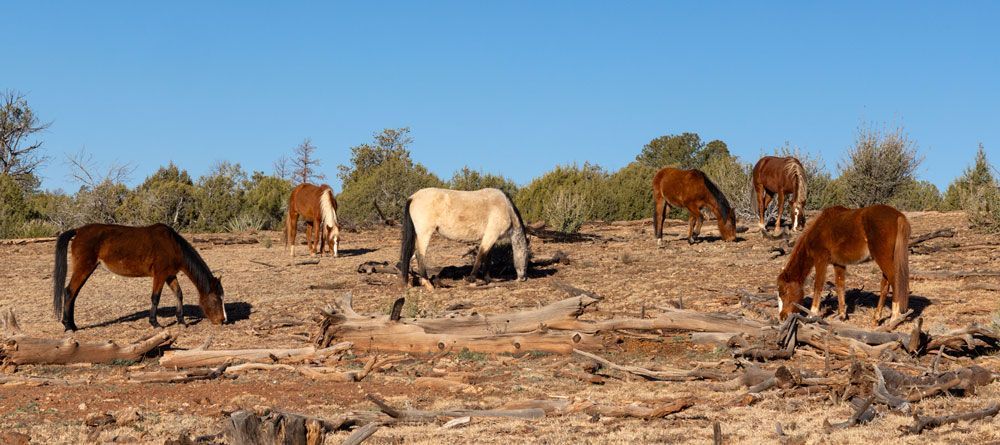
I asked Doug and Rhonda Forsha to travel to Heber and capture the beauty of these wild animals with their cameras for this article. Unfortunately, as soon as the Heber Wild Horse Territory Management Plan was released, officials announced the roundups would take place soon. Many of the horses you see on these pages will be herded into corrals and shipped to holding pens, taking away the one thing that made them the truest testament of the wild west — their freedom and our wildness.
The Heber Wild Horse Territory Management Plan is now out and about to be implemented. There are many Heber Wild Horse pages on Facebook that will have updated information. OSW will have the Management plan PDFs on our website. Please read them.
NOTE: A few weeks ago, they discovered that someone had shot and killed nine horses in the Heber Wild Horse Management Territory. If anyone knows anything about these shootings, be human(e) and please contact the Black Mesa Forest District. I am sure that forest agencies will soon catch whoever is shooting these horses. (It’s not the first time.) History tells us they can’t hide forever.
David Philipps is a Pulitzer prize winning journalist and author.
*Del Rio: Slaughter Pipeline Scandal (1990s-2010s): Investigations revealed that the Bureau of Land Management (BLM) adoption program was funneling thousands of federally protected wild horses to contractors who then sent them to slaughterhouses in Mexico, violating U.S. law against domestic horse slaughter.
Del Rio Connection: Investigations into these practices involved entities and individuals in the Del Rio area, with allegations of falsified records and conspiracy to profit from these sales.
SIDE NOTE
In Philipps’ book, he speaks about the white stallion that is so elusive no man can catch him. The stallion is written about in fables and legends, in books such as “Wild Horse Mesa” by Zane Grey. No one ever captures the stallion, and he remains a symbol of freedom and the wildness of the West. However, Philipps’ book ends with the demise of the White Stallion. He visualizes the stallion being chased by men, as has happened throughout the eons, and the stallion is galloping through the desert. His only chance of survival is to head up into the forest and the high cliffs — but there lurks even more danger under the canopy of the pines. The men are still chasing him, so he heads into the pass and sees an opening on the other side. Right then, a mountain lion lands on his back from above — it was quick. Philipps states,
“The life of the horse had gone out, but he had not submitted to the thralldom of man.”
The wildness of nature ended the life of the great white stallion — as it should be.