Now that the bears have settled down...
By Dan Groebner
After a spring, summer and fall of relentless bear assaults on our bird feeders, things are finally starting to settle down as the bruins can’t resist the urge to settle in for the winter. Local residents learn to remove their bird feeders or get them high enough out of a bear’s reach in the spring. But sometimes it takes a couple of unplanned disassembly of feeders for summer residents to figure out that bears are the culprit, not a mischievous raccoon or something less dangerous.
Fortunately, our small feathered friends usually have plenty to eat during the summer, so feeders are not needed or even used that much. The exception would be hummingbird feeders, but those can be placed high enough out of a bear’s reach and easily maintained with a long pole and a hook on the end to remove and replace the feeder from a nail on the house or a high loop around a tree branch. Just don’t use too large of a feeder or too small of a hook to hang it from.
Removing and cleaning hummingbird feeders can be as much a rite of fall passage as is getting your winter feeders ready to go. Using seed feeders during the summer months requires much more cleaning and maintenance to prevent diseases from spreading, so you’re safer to wait until it cools off in the fall to start seed feeding in earnest.
Even if not used during the summer, most feeders need some touching up before being deployed in the fall. Platform, tray, or shelf feeders need to have low upright sides to prevent seed from just falling off the platform onto the ground, and vertical tube feeders may need their outlets fixed or replaced. The feeder outlets are designed for different-sized seeds usually, so don’t use a thistle or nyjer seed feeder with the small outlets and buy the large oiled sunflower seeds. The birds won’t be able to pull the seeds through the small holes.
Sunflower seeds, as well as the mixed bags of different seeds, work well with platforms and tray feeders and the “mini-house” looking feeders that usually have clear sides with long gaps on the bottom. Sometimes they are called hopper feeders because you can fill their large hopper reservoirs from above.
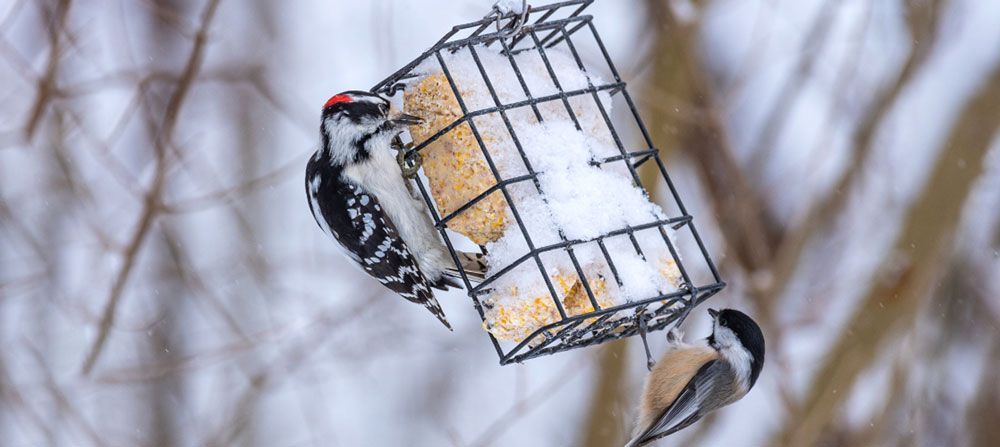
The key to bird feeding is making sure the birdseed fits the feeder so the birds can freely get to the food and it doesn’t just all spill out on the ground. We’re lucky to have a large variety of winter birds that can feed on a range of seeds and even the suet cakes, which attract many types of woodpeckers. The stellar jays and larger birds love the sunflower seeds, while the smaller nuthatches and chickadees prefer the smaller bits.
Try to avoid the small bags of bird food that are made of a variety of different seeds, especially the small red seeds. These mixes are not very tasty for the birds, and you might only get one star on your Yelp review by the local birds.
There are good mixes of bird seed available; just look for ingredients like safflower and millet. Many people use corn and peanuts, but if these hit the ground, it can attract rodents, raccoons and even javelinas. Since the seeds are larger, they can also spoil sooner if they get wet.
Suet cakes are being offered in many recipes these days, many with small bits of fruit and nuts. These suet cakes are just the right size to fit in the rectangular cage feeders, which makes it easy to refill with a new cake from an opening on the top. The birds probably won’t miss the smorgasbord of flavors if you cut costs and just use plain lard or rendered fat in the feeder and maybe add your own little seed and fruit treats.
Placement of your feeders can make a big difference to the birds. A safe bet would be to use multiple feeders in different locations with different seeds to cover all your bases. Some birds prefer to feed on the platforms out in the open, while others will use the suet feeders that are mounted on tree trunks and the tube feeders near brushy cover high enough to be out of a cat’s reach.
Many people place their feeders where they can be comfortably observed from indoors, but try to make your windows as visible to the birds as possible with stickers, screens or maybe even a layer of White Mountain malapais dust. Window collisions are a leading cause of injury for birds in the urban environment.
Studies have shown that window collisions are minimized when the feeder is less than three feet and over 20 feet from windows. So they get used to it when the windows are close and they avoid them when the windows are further away. You can still position a telephoto camera, spotting scope or binoculars on a tripod pointing directly at the feeder so that it’s ready to go for that new bird that just showed up.
The biggest trick in mounting the feeder is trying to keep the local squirrels from making your seeds disappear in a day! They need to eat too, but they usually spill more seed on the ground than they eat. The birds provide enough spillage for the squirrels, so they rarely need the easy pickings of a hopper, tube or platform feeder.
Squirrel proofing can involve mounting your feeder on a pole with a large circular “skirt” around the pole to prevent squirrels from climbing it. The skirt or cone needs to be made of chew-proof material; otherwise, the ambitious rodents will find a way through. And the pole can’t be within the jumping distance of a large squirrel from a nearby tree branch. We don’t have real flying squirrels in the White Mountains, but there are a few who keep trying out for the role.
Hanging a feeder on a rope from a branch might work also, if you use an “umbrella” over the top of the feeder large enough to keep the critters from getting to the feeder. Many versions are sold, but you can also fashion one yourself.
As they say, “If you build it, they will come” certainly applies to bird feeders. It may take a week or so to get the local birds familiar with your new offerings, but they won’t forget if you keep the feeder well stocked and never run out of seeds. Then the fun starts in trying to identify all your new neighbors, which is easier than ever before.
There are many bird apps that help you identify unknown critters and provide a bunch of interesting life history information. The Merlin app from Cornell University is the best free one available, and it even includes the ability to identify birds by their calls. For more detailed information, you can use iBird Pro if you can afford the annual subscription.
You can also submit photos of birds for a Google search these days and get results that you might have to sift through, but are a good place to start. But the best tried and tested method for bird ID is the good old field guide, like the Peterson or Sibley Field Guide series of books. Believe it or not, they don’t need to be charged, and they work just fine without internet connectivity!
To learn even more about bird feeding and become involved with the global community of birders, log into programs such as
FeederWatch (https://feederwatch.org/),
eBird (https://eBird.org),
or iNaturalist (https://www.inaturalist.org/).
These apps can also alert you to new birds in the area and help you keep track of the list of birds you have seen. They also leverage citizen scientists to make observations that add to our understanding of bird migrations and life histories.
The Audubon website also provides hours of information (https://Audubon.org) or
White Mountain Audubon
https://www.whitemountainaudubon.org
We’re lucky to live in the White Mountains, where we don’t have to travel very far to see a vast variety of wildlife. But if we set up our feeders right and maintain them, we can get the wildlife to come to us, right outside of our window!!