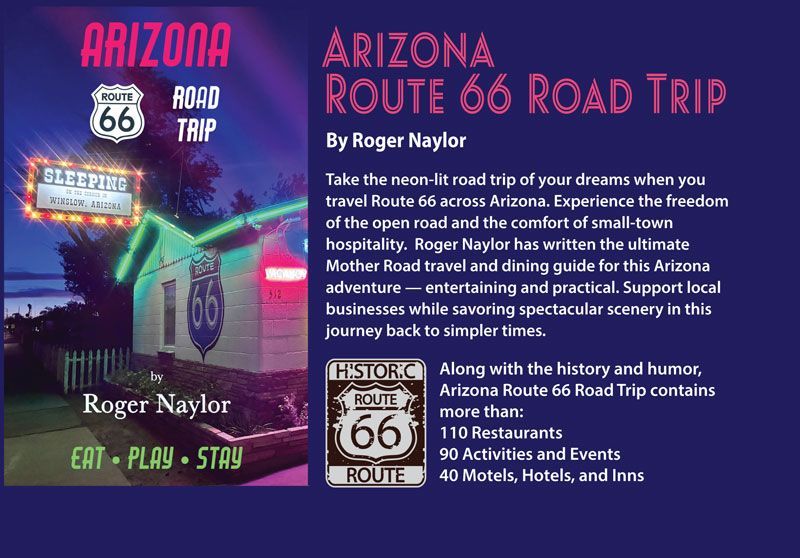
Roger Naylor's newest book about the Mother Road!
By Roger Naylor
It’s hard to believe because she looks so young and vibrant with seductive curves and bright neon smile, but the Mother Road is turning 100.
Route 66 sprang to life on November 11, 1926. The highway stretched from Chicago to Los Angeles, over 2,400 miles, while passing through eight states. Its meandering diagonal route was intentional, linking hundreds of rural communities. This earned Route 66 a well-deserved nickname as the “Main Street of America.”
During the Great Depression, the Mother Road was a lifeline for emigrants escaping the Dust Bowl. When America went to war, it became a vital corridor for the construction of military bases, and the movement of men and munitions. In the post-war era, Route 66 hit its heyday, launching a boom of automobile tourism. The modern road trip was born.
The highway grew into a pop culture legend, symbolizing freedom and a sense of adventure, immortalized in novels, movies, songs, and television. Route 66 connected us as a nation and defined roadside culture. This twisting road became the neon-lit pathway to the American Dream — one that happened to be lined with teepee-shaped motel rooms and juicy burgers sizzling on a flattop.
Sadly, with the rise of the interstate system, the old road became a relic. In 1985, US 66 was officially decommissioned. All signs were taken down, and it was removed from maps. America had lost its Main Street. Yet we’re still celebrating it today, and that’s due to the vision and hard work of a few Arizonans. We’re the state that saved Route 66. How cool is that?
The Guardian Angel
I got interested in Route 66 years ago when I stopped for a burger. I pulled off I-40 to eat in Seligman, a small town on the high grasslands of northern Arizona. A sign declared Seligman to be the Birthplace of Historic Route 66. But what caught my eye were four tour buses parked downtown.
It was a Tuesday morning in the middle of nowhere, yet tour groups from France, Germany, and Japan were unloading. As I stood there, a group of motorcycle riders from Belgium roared up. Everyone streamed towards a small barbershop. Crowds that couldn’t squeeze inside stood on the sidewalk snapping photos.
“Holy cow,” I thought. “Just how good is this barber? Is Edward Scissorhands working?”
That was the day I met Angel Delgadillo, the small-town barber credited with leading the preservation movement that brought Route 66 back from the dead. Seligman, like so many towns bypassed by the new interstate, struggled to survive. Where once thousands of cars streamed through daily, they now hurtled past on I-40. Businesses shuttered, and residents fled.
In 1987, Angel Delgadillo organized a meeting of concerned business owners. They formed the Historic Route 66 Association of Arizona, the very first of its kind. They lobbied the state to designate Route 66 a historic highway and, lo-and-behold; they succeeded. That provided a blueprint for all other states to follow. Today, the ribbon of pavement is back, now known as Historic Route 66, and it’s about to turn 100 years old. There’s no better time to take a road trip. The most famous highway in the world slashes through our backyard.
My latest book
I wanted to celebrate all of that with my latest book, Arizona Route 66 Road Trip. While providing plenty of history, I focused on just how amazing the Mother Road is right now. I wanted this to be the ultimate Route 66 guide across our state, just in time for the centennial. The book is hyper-local, packed with more than 110 restaurants, 40 motels, and 90 activities and events. Arizona Route 66 Road Trip gives readers a chance to support local businesses while savoring spectacular scenery, in a journey back to simpler times.
Route 66 in Arizona crosses stark badlands, cloud-swept plateaus and a desert painted in scandalous hues. The road explores forests of tall pines and forests where trees have turned to stone. It brushes past volcanoes, craters, and the ruins of ancient civilizations. Amid the scenic splendor, the highway passes through small towns and the skeletons of towns. If the Grand Canyon is the beating heart of Arizona, then Route 66 is the main artery.
What to know
From the east, Route 66 enters the state on the Navajo Reservation at Lupton. It continues across the northern half of Arizona, passing through towns like Holbrook, Winslow, Flagstaff, Williams, Seligman, Kingman, Oatman, and finally Topock before continuing into California.
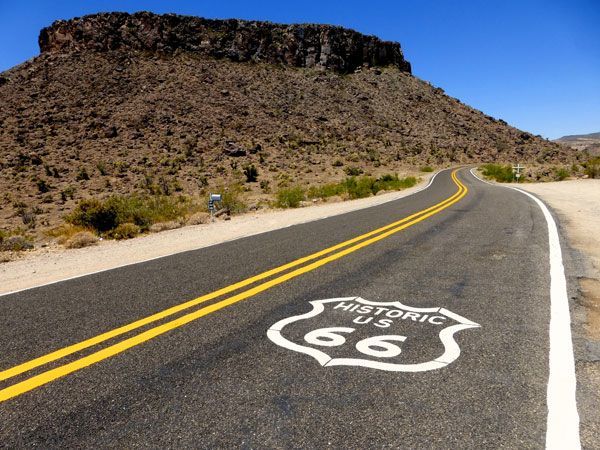
Most of the eastern half of Route 66 in Arizona is submerged beneath I-40, leaving orphaned segments at exits and towns. But don’t be discouraged. Arizona has over 250 miles of drivable Route 66, including the longest unbroken stretch of Mother Road in existence, 158 miles from west of Ash Fork (Crookton Road, I-40 Exit 139) to the California border.
In 2009, Historic Route 66 in Arizona was designated an All-American Road, the highest rating available, signifying a road that’s a destination unto itself.
A few favorite places (east to west)
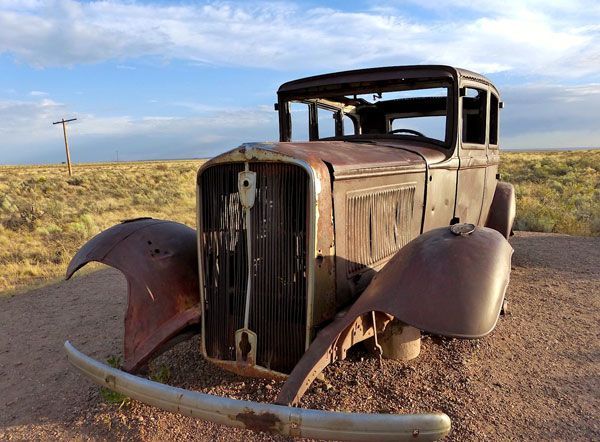
Petrified Forest National Park — the only national park Route 66 crosses, features a roadside pullout commemorating 66 with plaques and the rusted hull of a ‘30s sedan. A string of weathered telephone poles traces the old alignment, a silent reminder of what once existed, like the chalk outline at a murder scene. 928-524-6228, www.nps.gov/pefo.
Jackrabbit Trading Post, Joseph City — yellow signs adorned with a swoop-eared hare once stretched across the country promoting this iconic stop. You’ll find a great selection of souvenirs and support a longstanding mom-and-pop business. Be sure to climb into the saddle of the giant jackrabbit for a memorable photo op. 928-288-3230, www.jackrabbittradingpost.com.
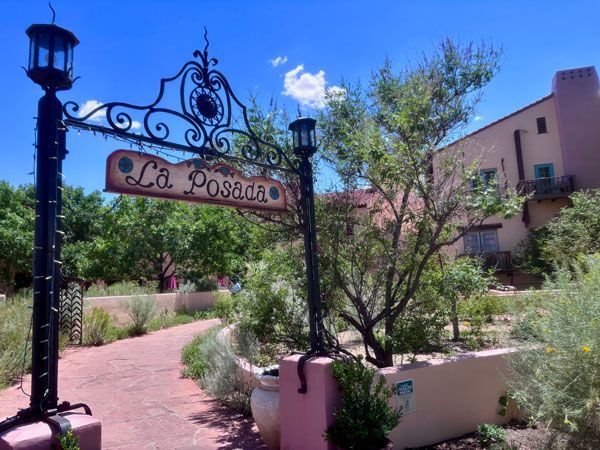
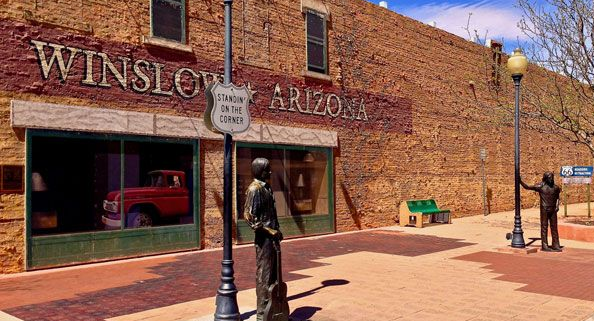
La Posada Hotel, Winslow — the last of the great Santa Fe Railroad hotels, and Mary Colter’s masterpiece of graceful design, has been exquisitely restored. The airy, romantic, hacienda-style building on the verge of demolition was saved by individuals. That’s very much the story of Route 66’s rebirth. While there, dine in the fantastic Turquoise Room. 928-289-4366, www.laposada.org.
Neon of Williams - Route 66 didn’t invent the neon sign, but it perfected it. Pull into this charming burg — the last Route 66 town bypassed by interstate — and you’ll find saloons, restaurants, motels and shops bathed in the liquid velvet of neon. Sidewalks are crowded with people, and music spills from every open doorway as traffic slow-rumbles along the Mother Road.
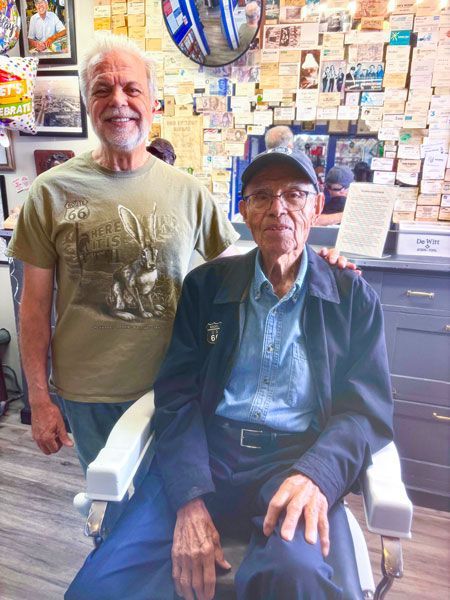
Seligman — pay a visit to the most famous small-town haircutter in the world. Angel Delgadillo, who will celebrate his 100th birthday a few months after Route 66 does, still holds court at the Original Route 66 Gift Shop. He signs autographs, poses for photos, and tells stories to a rapt audience. 928-422-3352, www.route66giftshop.com.
Keepers of the Wild — a non-profit rescue sanctuary in Valentine for abused, neglected and abandoned exotic animals. Tigers, lions, wolves, leopards, bears, and monkeys all lounge in roomy habitats. 928-769-1800, www.keepersofthewild.org.
Hackberry General Store — a store, museum, and shrine all rolled into one. Hackberry is a can’t-miss destination, just east of Kingman, overflowing with antiques, memorabilia, and vintage vehicles. Stop for a cold drink and spend an hour browsing the collection. 928-769-2605, www.hackberrygeneralstore.com.
Where to eat (east to west)
Cajian, Winslow — Cajun spice meets Asian rice in a fusion of cuisines. They’re known for ramen creations, poke bowls, and heaping mounds of fried rice. The char siu pork fried rice is a perennial favorite, using red seasoned pork marinated for 48 hours until it melts in your mouth. 122 E. Second St., 928-882-8681.
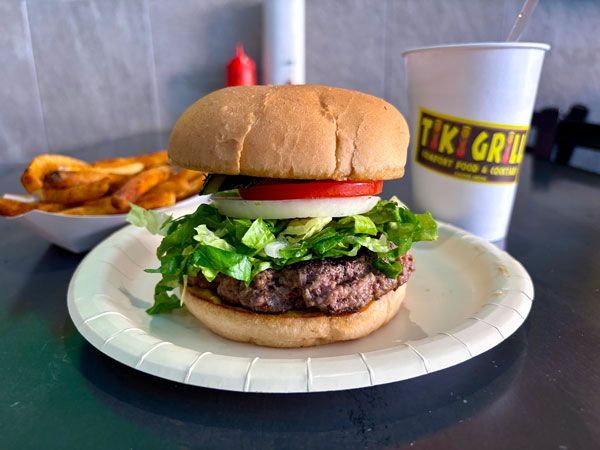
Tiki Grill, Flagstaff — tucked in a strip mall, unassuming Tiki Grill has a laid-back island feel and flavors so authentic you’ll swear you can smell an ocean breeze. Diners enjoy a delicious blend of scratch-made mainland and seafood dishes. Fish and shrimp tacos can be grilled, blackened, or fried. 1509 S. Milton Rd., 928-440-3693, www.tikigrill.live.
Diablo Burger, Flagstaff — in downtown Flag, Diablo Burger serves tender, delicious burgers made using open-range, antibiotic-free beef from local ranches. By using sustainable beef, they help preserve open spaces and restore healthy watersheds. The lean patty is cradled on a light, crisp English muffin. 120 N. Leroux St., 928-774-3274, www.diabloburger.com.
Westside Lilo’s, Seligman — opened in 1996, Westside Lilo’s quickly developed a reputation for scratch-made food in plate-draping portions. Along with German specialties, the eatery features cinnamon rolls as big as hubcaps, sinfully rich carrot cake, and cream pies made with mascarpone cheese. You can always diet tomorrow. 22855 Historic Route 66, 928-422-5456, www.westsideliloscafe.com.
Kingman Airport Café, Kingman — pilots can almost taxi up for a takeout order at Kingman Airport Café, which serves breakfast and lunch all day. Café walls are covered with historic photos. The airfield was established during World War II as an Aerial Gunnery Training Base for 35,000 airmen, including Charles Bronson and Clayton Moore. 6000 Flightline Dr., 928-757-4420, www.kingmanairportcafe.com.
The healing power of road trips
We live in strange times. Technology has upended our perceptions. Never have we been so far removed from the authentic world around us. Artificial intelligence, virtual reality, chatbot relationships—everything feels vague and blurred around the edges. You can’t make memories scrolling through other people’s memories. We need experiences of our own. Let’s put some skin back in the game. Let’s hit the road again.
A road trip gives us back our equilibrium. It reestablishes a sense of place for us. Ever since the hunter and gatherer days of yore, we have been a mobile species. Travel is etched into our DNA. Nothing relieves stress and worry like a long stretch of open road. We feel the curves and dips in our bones. The unhurried pace is a balm for cyber-scalded nerves. The road pulls us ever on, and the horizon throws wide its arms in welcome. When our windshields wear the splotchy dabs of insect shrapnel and our tires sing on the asphalt and the wind howls in jubilation past our open window, then we are truly free. Road trips remind us that life doesn’t always have to be complicated.
We ride toward the sunset. Or the sunrise. Or beneath a blanket of stars or wrapped in the pale shimmer of an Arizona moon. We ride toward the next town. Or the one after that. We ride like we are lost. We ride like we are found. We ride toward the middle of nowhere. Then we go a little farther.
In the end, we ride toward our youth.
Roger Naylor is the author of Arizona Route 66 Road Trip. The book is available in stores, on Amazon, and through his website, www.rogernaylor.com.