
HIKING THE GREENS PEAK AREA...
Deep in a small patch of forest, hidden among white pine, Ponderosa, spruce and aspen, in a clearing of a respectful circumference of several feet, is an ancient Douglas Fir — and it’s not your every-day, ordinary fir — it is a patriarchal fir. If you were to hike past it you might not know that it took 16 people standing shoulder to shoulder to wrap around its trunk or that, if you look closely, the bark is incredibly thick with detailed scrolling texture like something out of the Dark Crystal or the Hobbit. And something else that you might not think about is what it has seen in its hundreds (or even thousands) of years of existence — the history that has taken place under its boughs — and you might not know that its name is Coyote Fir.
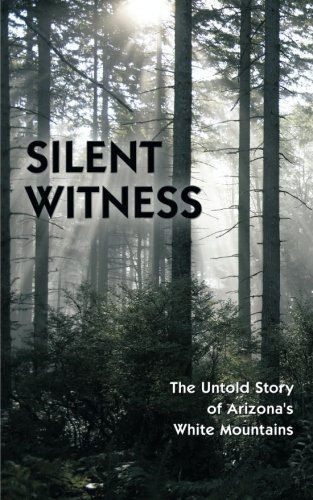
In the book, “Silent Witness,” by Tom Jernigan, historical events took place under the Douglas fir beginning on October 14, 1463 at 4 a.m. It started with the slaying of a deer by a Hawikuh Indian named Coyote. He takes the broken arrow that he used from the deer and lays it across the branches of the young fir and says: “Remember me, little tree, I am Coyote and I have had success here this day.” — and so, begins the chronological events that make up the history of the White Mountains of Arizona. From the Native Americans who lived and hunted in the area; the Spaniards who came through on their search for the Golden Cities; the fur trappers and mountain men, the pioneers and the loggers as well as a variety of wildlife — predator and prey.
“The stately little Coyote Fir is a silent witness to the life and death struggles that take place nearby.” Jernigan writes. “Perhaps somewhere in its molecular structure, in a way that we have yet to discover, it records these events.”
The Coyote Fir is located at the foot of Greens Peak — a cinder cone that is located in the highest part of the Springerville Volcanic Field. This series of mountains were created by violent eruptions that started around 760,000 years ago.* If you’ve ever ventured out on Arizona Route 260, heading east from Pinetop through McNary and past the Sunrise Park Resort junction (AZ Route 273) toward Greer and Springerville, then you have probably seen Greens Peak, to the north, off in the distance. It’s the rounded peak with radio towers adorning its crest. If you find the Railroad Grade Trail (on the south side of the road — and a great restroom stop), the road to Greens Peak, Forest Road (FR) 117, is just past it to the north. If you turn left onto FR 117 and follow it until you reach FR 61, you will be at the foot of Greens Peak.
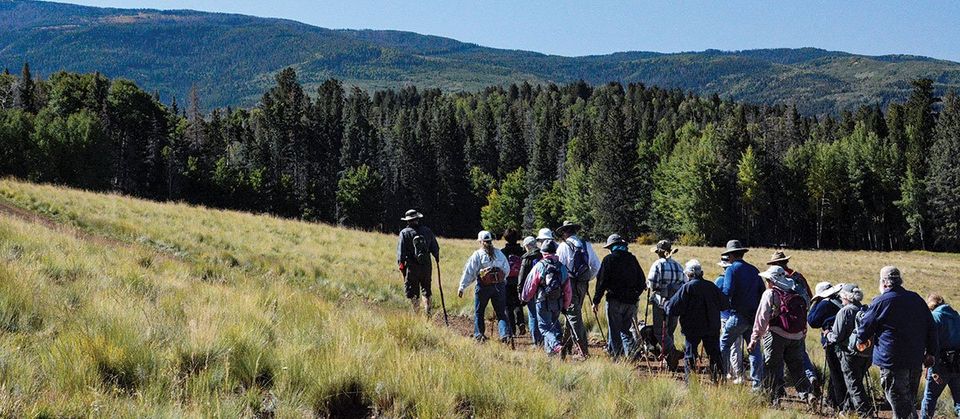
Just before reaching FR 61 on the left of FR 117, is a parking area and that is where we -- 34 TRACKS members and I -- started hiking last Wednesday. We were guided by Ron Miller, who we affectionately refer to as the “tree whisperer.” Miller retired from the Bureau of Indian Affairs (BIA) as a forester. His knowledge of trees is pretty amazing.
Miller led us through a patch of trees, showing us an Engleman Spruce that was improperly cut for a Christmas tree. He explained how the main crown was split into two branches. After emerging from inside the forest, we skirted the trees on our left with views of meadows and Greens Peak on our right. Just around a curve in the trail, a few of us spotted a challenge — a mountain with a trail to its peak. Starting at around 9,500 feet in elevation, about five of us climbed the steep 400 additional feet to the top where the views were incredible! — Escudilla to the southeast, Sunrise Peak to the south and St. Peter’s Dome to the north.
After our descent, we met up with the rest of the group further down the trail and found that they had discovered a giant white pine with enormous pine cones. The hike took us over five miles to return to the parking area. Afterwards, Tom Jernigan, author of “Silent Witness,” offered to take anyone interested to see the Coyote Fir. Leaving the parking lot, we turned left on FR 117, traveled past the Greens Peak road to a campsite and parked. Then Jernigan led us down a trail deep into the woods to a small clearing where stood the largest tree I have ever seen in this part of the state. A patriarchal tree named the Coyote Fir. It was unbelievable.
If you visit the Greens Peak area, make sure you read Jernigan’s book “Silent Witness” before you go. The directions to the tree are in the book. I just bought it at the White Mountain Nature Center.** I read it, and now I am heading back to Greens Peak. The White Mountains area is truly an amazing place.
*From the “Guide to the Geology of the White Mountains and the Springerville Volcanic Field, Arizona. By John V. Bezy and Arthur S. Trevena. Arizona Geological Survey. (Link )
**All the proceeds from the sale of “Silent Witness” by Tom Jernigan, are donated to the White Mountain Nature Center, located at 425 Woodland Rd, Lakeside, AZ 85929. Cost is $10.
Adopt an Acre at Woodland Lake Park

TRACKS August Local Hero: Nick Lund

An interview with Greg the Sasquatch of Sasquatch Honey Bees
Mount Lemon: A Gift and a Challenge

The Life and Times of Lee and Lea Fulmer
All about Termites...

Greeting Friendly Canines
The White Mountain Trail System
Facing Big Decisions

The Art of Linda Lucas